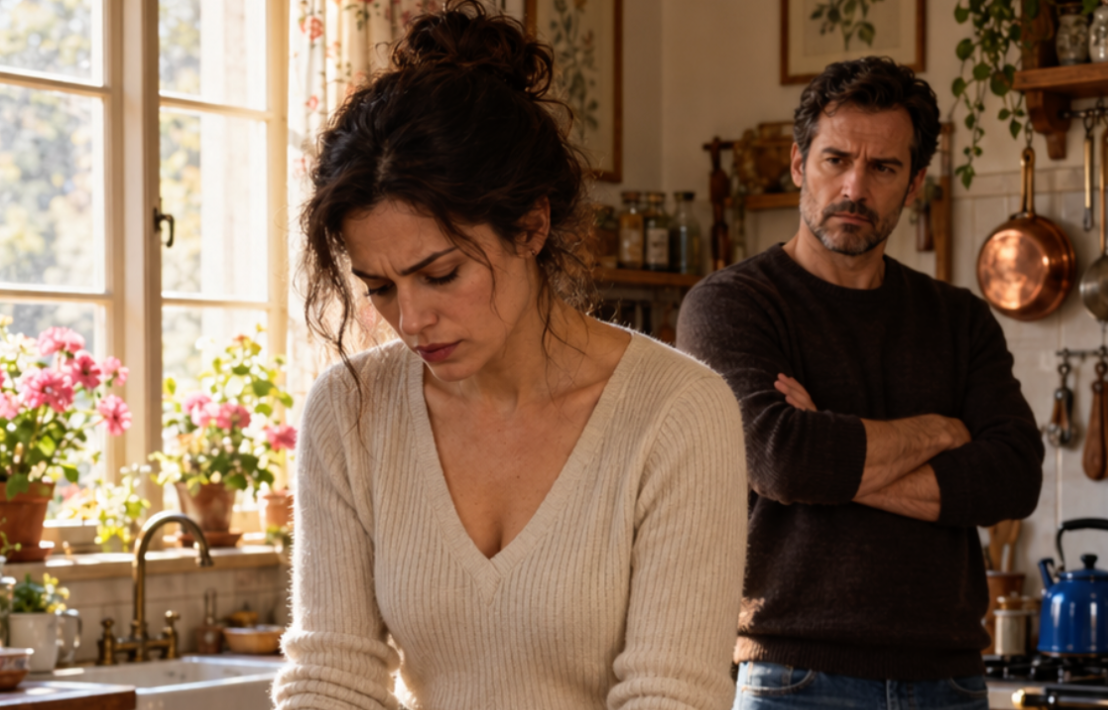
Her Husband Spent Twenty Years Away on Work Rotations While She Raised Their Children and Grew Older Alone—Until One Day, She Had Had Enough
Tatyana woke sometime after four in the morning, out of a habit she had been unable to shake for twenty years. Outside, it was dark. The wind moaned in the chimney. She lay staring at the ceiling for a while, then sat up and lowered her feet onto the cold floor.
Mikhail was into his third month away at work. He had left in January, promising to return by March. In March, he called.
“Tanya, the boss has asked me to stay another two months. The money’s good. How are you doing?”
“Stay,” she answered.
Then she hung up.
The money was good. Twenty years of “the money’s good.” Twenty years of “How are you doing, Tanya?” Twenty years alone.
She pulled on her robe and went into the kitchen. It was a large, traditional timber house, the one she and Misha had built together in the early 2000s. Back then, children had run through its rooms, cried at night, and rattled their toys. Now the house stood empty, echoing like a hollow barrel.
Lena had been living in the city for five years. She had trained as an accountant, found a job with a company, and rented an apartment with a friend. Dima was up north, following in his father’s footsteps: work rotations, oil, money.
And Tatyana was alone.
Alone in a large house with four bedrooms, though she slept in just one—the smallest, closest to the stove.
She poured herself some tea and sat by the window. A geranium stood on the sill—an old one that had belonged to her mother and survived three repottings. Tatyana looked at it and suddenly thought, I’m just like that geranium. Someone replanted me, waters me now and then, and I keep living. But what am I living for?
The thought had not come to her yesterday, or the day before. It had been growing for a long time. Like an abscess that does not hurt at first, then suddenly bursts—and you realize things cannot go on this way.
For twenty years, she had waited for her husband to return from his work rotations. For twenty years, she had raised their children, kept the household running, and answered his calls once a week.
For twenty years, she had repaired the fence herself, carried in the firewood herself, and sat up alone at night when the children had fevers. She had gone to parent-teacher meetings alone, decided what to do about the leaking roof alone, and buried their old dog herself when it died.
She had spent holidays alone.
She had watched herself grow older in the mirror alone.
And Misha would come home for a month or two—grimy, exhausted, happy, with money in his pockets. He brought presents, played with the children, and fixed everything that had piled up.
Then he left again.
And she stayed behind again, waiting.
At first, she waited with worry and longing. Later, out of habit. Later still, simply because that was how things were.
But now the children had grown up and moved away, and she suddenly realized there was no one left to wait for. Misha barely came home anymore. And when he did, they sat at the table in silence.
What was there to talk about?
His world was work rotations, machinery, the guys, the boss.
Hers was the vegetable garden, the chickens, the neighbors.
Two different universes that, for twenty years, had crossed paths nowhere except inside this house.
And the house held her there, too.
Like an anchor.
Like a sentence.
She finished her tea and stood up. She went to the wardrobe and took out an old suitcase—the very one she had brought to this house as a young bride.
She opened it and packed: jeans, a sweater, underwear, her passport, money. Not much. Only what would fit.
She did not need the rest.
Then she sat at the table and wrote a note. Without anger or accusation. Just:
“Misha, I’ve gone to the city. I don’t resent you. I’m just tired. Live however you think best. Tanya.”
She placed the note in the middle of the table and weighed it down with the salt shaker so it would not blow away. Then she put on her coat, wrapped a scarf around her neck, and picked up the suitcase.
She stepped onto the porch.
It was late March. The snow had already melted, and the earth smelled of thawing leaves and damp soil. Birds cried overhead, returning from the south.
Tatyana stood on the porch for a moment, looking at her yard, the crooked fence, and the old bird cherry tree beside the gate.
Then she locked the door.
She left the key under the mat—an old village habit—and walked to the bus stop.
The minibus journey to the city took three and a half hours. Tatyana sat by the window, watching forests, fields, and scattered villages drift past.
Not once during the journey did she look back.
Mikhail returned in the middle of April.
He caught a ride home, a backpack over his shoulder and his earnings in an envelope, as always. He was tired, unshaven, and smelled of diesel fuel and metal.
He opened the gate—and froze.
The house was dark.
No smoke rose from the chimney. No light shone in the windows.
But Tanya always waited for him. She always lit the stove before he arrived. She always came out onto the porch, wiping her hands on her apron, smiling—tired, but warm.
For twenty years, she had come out to meet him.
Now she did not.
“Tanya!” he called into the emptiness.
Silence.
He went to the door and pulled at it. Locked. He bent down, felt beneath the mat, and found the key.
Inside, the entryway was cold and smelled uninhabited. The kitchen was clean, the dishes washed, the stove cold.
On the table lay a note.
He read it.
Sat on a stool.
Read it again.
“I don’t resent you. I’m just tired.”
Mikhail sat there for a long time—perhaps an hour, perhaps two.
The house was quiet. Wind moaned in the chimney. Somewhere far away, a dog barked.
He stared at his hands—large hands, dark with grease, with broken nails. Hands that had earned enough over twenty years to pay for a house, the children’s education, everything.
And it turned out that none of it had been enough to keep his wife.
He stood and walked through the house.
In the bedroom, half the wardrobe was empty. Her things were gone. On the bedside table stood an old photograph of the two of them at their wedding.
Young. Foolish. Happy.
He picked it up and sat on the bed.
And suddenly, for the first time in years, he cried.
Silently, without a sound. Tears ran down his cheeks, and he did not wipe them away.
Twenty years.
For twenty years, he had gone away on work rotations. For twenty years, he had thought, I’m doing well. I’m providing for my family. I built a house. Put the children through school. Did everything right.
And now the house was empty.
His wife had left.
The children were far away.
What had he earned, really?
He remembered.
Lena’s first-grade school performance. He had promised to come, but his rotation had been extended.
Dima taking first place in a skiing competition. He had not been there. He had only heard about it over the phone three days later.
Tanya in the hospital with appendicitis. The neighbors had taken her. He had found out a week afterward.
And so it went. Every year, every month, every single damned time.
He was always somewhere a thousand kilometers away, earning money, while life went on here without him.
And now that life was over.
It had not shattered or exploded. It had simply ended.
Like fuel running out in a tank.
Like the patience of someone who had waited twenty years.
He took out his phone and called his daughter.
“Lena. Is your mother with you?”
“Dad?” Her voice trembled. “Yes, she’s here. Dad, she told us everything. She… she’s left you.”
“I know,” he said. “Put her on.”
Silence. Then footsteps.
Then Tanya’s voice—calm and steady, nothing like the voice he remembered.
“Yes, Misha?”
“Tanya, what… what are you doing?” He could not find the words. “Everything I did was for you. I… I built the house. Paid for the children’s education. It was all for the family. And you just up and left. Without talking to me. Without anything.”
She was silent. Then she said:
“Misha, you did everything for us. I know. I don’t blame you. You’re a good man. Honest, hardworking. You never spent a ruble on yourself—it all went into the house, all to the children.
“But there was no room for me in that house, Misha. For twenty years, you came home, but I was already gone. I was the stove that kept it warm. I was the dishes that needed washing. I was the garden that needed digging. But there was no person left. Do you understand?”
He said nothing, gripping the phone.
“Tanya…”
“Don’t, Misha. I’m not fighting with you. I’ve simply left. Lena will help me. I’ll find a job. I spent twenty years living alone. Now I want to live for myself. I don’t mean to hurt you. It’s just how things turned out.”
She spoke calmly, with no trace of the woman who had greeted him on the porch for twenty years.
There was weariness in her voice, but no bitterness. Only a kind of finality.
The voice of someone who had already made her decision.
“Tanya…” He swallowed. “I’ll come. Tomorrow. Just let me talk to you. Let me look you in the eyes.”
“Come,” she said. “But don’t come to take me back, Misha. I’m not coming back. Don’t ask.”
Then she hung up.
Mikhail did not sleep that night.
He sat in the kitchen of the unheated house, still wearing his jacket because of the cold, staring at the note.
“I don’t resent you. I’m just tired.”
He read those words over and over, as though the meaning of his entire life were hidden inside them.
And the longer he looked, the more clearly he understood: she was right.
A person cannot spend twenty years doing nothing but waiting.
Cannot be a stove someone lights once every six months.
Cannot be a home someone only visits.
He remembered how she used to come to the railway station in the district town to see him off. Five years ago. Ten. Fifteen.
In the first year, she had cried and hugged him, reluctant to let him go.
By the fifth, she smiled faintly.
“All right, then. Call when you get there.”
By the tenth, she simply waved from the porch. She no longer walked him to the gate.
By the fifteenth, she did not even come outside.
He would go into the house to say goodbye while she washed the dishes.
“Take care, Misha. Transfer the money to my card.”
He had not noticed then.
Now he did.
He noticed everything at once, as though a veil had fallen from his eyes.
And he remembered something else.
Five years earlier, he had come home from a rotation to find Tanya lying in bed, exhausted and drawn.
“What’s wrong?” he had asked.
“Oh, nothing. Blood pressure. I’m getting older.”
And he had believed her.
But perhaps everything inside her had already burned out by then.
He had simply never asked.
Had not wanted to ask.
Toward morning, he stood up, took out his phone, and called his boss.
“Petrovich, it’s Mikhail. I’m not coming back. At all. I’m quitting.”
“What’s gotten into you, Mikhailych?” His boss was stunned. “We’ve got six months of work lined up. Twenty years without a single problem from you. What happened?”
“Life happened, Petrovich. Twenty years without a problem—and my life passed me by. I’ve lost my wife. Do you understand? She hasn’t died. But I’ve lost her. I’m sitting in an empty house, crying my heart out.”
His boss was quiet for a moment.
“All right, Mikhailych. Hang in there. Call if you need anything.”
Mikhail hung up.
Then he packed a few things. Only the essentials.
Money. His passport. Their wedding photograph.
He locked the house and left the key under the mat, as always.
Then he set off for the city.
For the first time in twenty years, he was not traveling to earn money.
He was going to reclaim his life.
He rarely visited the city and had never liked it. The bustle, the noise, the unfamiliar faces.
But now he noticed none of it.
He got off at the bus station and realized he had no idea where to go.
He called his daughter.
“Lena, I’m in the city. Give me your address.”
“Dad, have you lost your mind?” Her voice held equal parts fear and hope. “You’ve only just got back from work.”
“I quit. Give me the address.”
She did.
He took a bus, then walked the rest of the way.
Lena rented an apartment on the outskirts, in a nine-story concrete apartment block. An ordinary residential neighborhood: a playground in the courtyard, benches, garbage bins.
Mikhail climbed to the fifth floor.
Stood outside the door.
Rang the bell.
Lena opened it.
She looked at her father, then suddenly threw her arms around him and held him tight.
“Oh, Dad… What are you doing, Dad?”
“Where’s your mother?” he asked hoarsely.
“In the kitchen. Having coffee. Come in. Just don’t shout.”
“I won’t,” he said. “I’ve done enough shouting. Twenty years’ worth.”
Tatyana sat by the window in the small kitchen.
She wore a sweater and jeans, looking unlike the woman in a robe he had seen over the past several years. Her hair was cut shorter. There was something new in her eyes—determination, perhaps, or peace.
She did not startle when he entered.
She simply looked up.
“Hello, Misha.”
“Hello, Tanya.”
He sat across from her.
Lena paused in the doorway, then quietly went into the other room and closed the door.
“You quit?” Tatyana asked.
“I did.”
“Why?”
“What do I need that job for if I don’t have you?”
He fell silent for a moment, studying his hands.
“Do you know what I realized, Tanya? It wasn’t just you I lost. I lost myself. I’ve lived forty-six years, and I don’t know who I am without that job. I built a house, but I don’t have a home. I raised children, but I didn’t see them grow up. I had a wife, but I don’t know who you really are.
“All my life, I thought I was the provider. The one everyone could rely on. The head of the household.
“But I… I was just a guest. A guest in my own home.”
Tanya said nothing.
He continued.
“Just tell me one thing. Can you still… Can you—what am I trying to say? Forgive me? Or maybe not forgive me. That’s not the point. Could you try again? Not the way things were. Differently.”
“How differently?” she asked quietly.
“I don’t know,” he admitted. “But I’m here, in the city. I have some money. Enough to get started. I’ll find a job. Any job. Sweeping streets, working construction—whatever it takes.
“I’m not going away again, Tanya. Not for a month. Not for a week. I spent twenty years leaving. Now I’ve come back. For good.”
Tatyana looked at him for a long time.
Her eyes filled with tears, but she did not cry.
“Misha,” she said at last, “I waited for you for twenty years. And when you came home, I was happy. Truly happy. You’re a good man. You’re not cruel or greedy. You don’t drink.
“You just… weren’t there. Do you understand? You weren’t there.
“And I got tired of being alone. I can’t wait anymore. I’ve forgotten how.”
“I’m not asking you to wait,” he said. “I’m asking you to be with me. Here. Now. To drink tea together in the mornings. Watch television together in the evenings. Go shopping together. Sit in silence together.
“For twenty years, I was somewhere a thousand kilometers away. Now I’m here. And I’m not going anywhere.”
“I’m afraid,” she said. “I don’t know if it will work. I’m used to being alone. I don’t know whether I can be with you when you’re here. Really here. Not for a month, but forever.”
“I don’t know either,” he answered. “But let’s try. As though we were twenty again. As though we’d only just met. What do you say?”
And suddenly, Tanya smiled.
Through her tears. Shyly. Uncertainly.
“Just met—at forty-six? You’re funny, Misha.”
“Why not?” He brightened. “Can’t people meet at forty-six? I know everything about you, and I know nothing. Look—you’ve cut your hair. It suits you.
“I never even used to notice how you looked. Everything was always rushed. Always in a hurry. But now I’ve noticed.
“You’re beautiful, Tanya. You were beautiful at twenty, and you’re even more beautiful now.”
“Oh, stop it.” She waved a hand. “Listen to you.”
“I’m telling the truth.”
Then he reached across the table and took her hand, carefully, as though for the first time.
“Tanya. Come on. Let’s try. I won’t leave again.”
And she did not pull her hand away.
Lena, who had been listening outside the door, wiped her tears on her sleeve and went into the other room.
Then she called her brother.
“Dima, you won’t believe this… Dad quit his job. He came for Mom. They’re sitting in the kitchen, talking.”
“You’re kidding!” Dima whistled. “Dad? Quit? I thought he couldn’t live without that job.”
“Apparently, he could,” Lena said. “Apparently, something else turned out to matter more.”
Mikhail found a job within a week.
A man he knew hired him as a mechanic at an auto repair shop. Mikhail was good with his hands, and people in the city quickly recognized it.
The pay was lower than on the work rotations, but it was enough.
He rented a room near Lena’s apartment.
“I’ll live separately for now,” he told Tatyana. “You should have your own space. Then we’ll see. Whatever you want.”
She said neither yes nor no.
Two days later, she came over carrying a jar of homemade pickles she had brought from the village cellar.
She set it on the table.
“I was thinking,” she said. “Maybe we could have dinner together?”
He nearly knocked over his chair in his excitement.
They sat in his tiny kitchen, eating potatoes and pickles and drinking tea.
They talked.
About the future, rather than dwelling on the past.
They remembered how, long ago, before the work rotations and the children, they had loved going to the movies. There had been an old cinema in the district town, and they went every Saturday.
Mikhail would hold Tanya’s hand in the dark theater, and she would rest her head on his shoulder.
“Listen,” he said. “Why don’t we go to the movies? There are cinemas here in the city.”
“The movies?” She smiled. “At our age?”
“What’s age got to do with it?” he protested. “You’re old when you stop wanting to go to the movies. And I want to go. With you.”
So they went.
On Saturday evening, just as they had twenty years earlier.
They sat in comfortable seats and watched some new film. Mikhail did not even remember which one.
He simply sat there holding Tanya’s hand.
And she did not pull it away.
By summer, they had decided not to sell the village house.
They would keep it and visit in the summer, for a month or two. The garden, the bathhouse, the river.
The rest of the time, they would live in the city.
Together.
They rented an apartment for the two of them. Small, but bright.
Mikhail put up shelves, repaired the faucet, and replaced the wallpaper himself. Tanya stood beside him, handing him tools.
And in that—in the way he hung a shelf while she passed him screws—there was more closeness than in twenty years of his visits home.
One evening, as they sat on the balcony looking at the city lights, Tatyana suddenly said:
“You know, Misha… when I left, I didn’t believe in anything anymore. I thought you’d come, make a scene, and leave again. Or maybe you wouldn’t come at all.
“But you… you quit. You came. You’ve been here beside me for two months, and not once have you said, ‘I did everything for you.’
“You just do things. Every day. You walk to work. Bring money home. Make dinner.
“You… you’ve changed, Misha.”
“I haven’t changed,” he said. “I’m just finally home. I wasn’t home for twenty years. Now I am.”
She was quiet for a moment.
Then she said:
“I love you, Misha. I always loved you. I was just tired. But I’m not tired now. I’ve had time to rest.”
He put his arms around her.
Below them, the city hummed: cars, trams, other people’s lives.
But on their balcony, they had a life of their own.
Quiet. Simple.
Finally shared.
In the autumn, they went back to the village to close up the house for winter.
Everything was where they had left it: the fence, the bird cherry tree, the geranium on the windowsill, though it had wilted a little.
Tatyana walked through the rooms, ran her hand along the walls, and stood in the kitchen.
The house smelled of loneliness.
But it was no longer her loneliness.
“You know,” she told Mikhail, “I thought coming back here would hurt. But it doesn’t. It’s as though this isn’t my home anymore.
“My home is there now, with you. In the city, in that little rented apartment.
“Funny, isn’t it? I lived here for twenty years, but my home is there.”
“There’s nothing funny about it,” he answered. “A home isn’t walls. It’s where someone waits for you.
“And now I wait for you. Every day. To come home from work. From the store. From the hairdresser’s.
“You go out, and I wait.
“And you know, Tanya… it turns out waiting isn’t so hard. It can even be a good thing.
“When you know the person you’re waiting for will come back.”
She walked over and took his hand.
“I waited twenty years,” she said. “Now it’s your turn.”
“It is,” he agreed. “And you know… I don’t mind. I’ll wait for the rest of my life.
“As long as you keep coming home.”