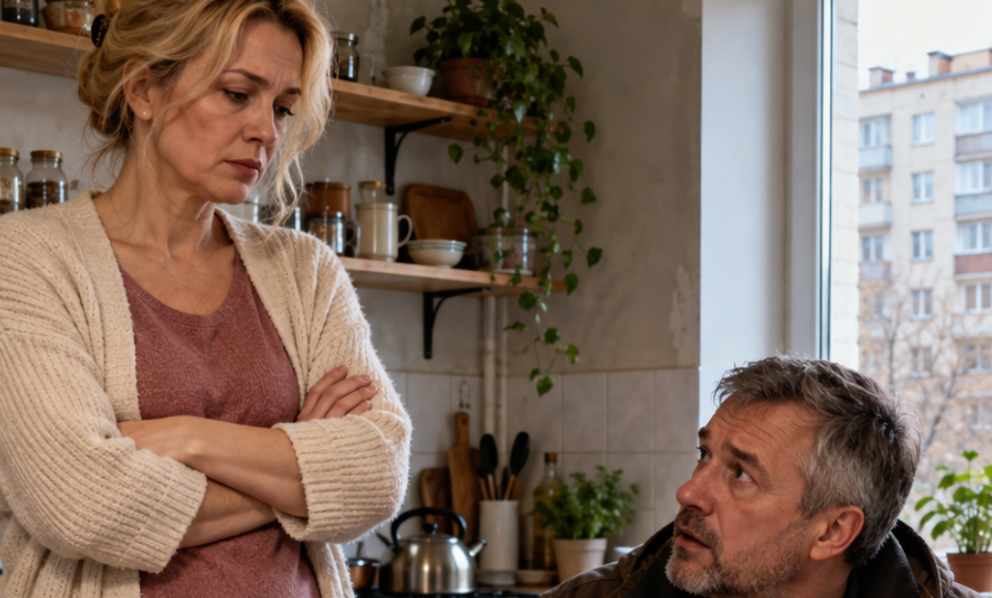
Her husband took half the apartment and announced that he was starting a new life. A week later, he came back for homemade cutlets.
Natalia watched the movers carry out the coffee machine and counted the scratches on the doorframe. Three of them. One was fresh, left by the corner of the chest of drawers that hadn’t made it around the turn.
Sergey stood downstairs beside the moving van, directing the process with the expression of a man who wasn’t moving out of the family apartment but out of an office he had grown tired of long ago.
“Are you taking the TV too?” she asked, even though she could already see that it had been removed from the wall and wrapped in plastic.
“I bought it,” Sergey replied without looking up.
He said it in the tone people used when reading items from an invoice. No anger, no guilt, no pause to look her in the eyes.
Natalia leaned against the doorway and thought that in twenty-two years of marriage, she had never seen him manage a group of strangers so efficiently. At home, he could put off hanging a curtain rod for three months.
When the van drove away, the apartment looked like a waiting room. Empty corners. Pale marks on the wallpaper where shelves had been removed. A television cable sticking out of the wall like a severed wire.
The kitchen was left with an old table, two chairs, and the refrigerator, which Sergey seemed to have left behind only because it wouldn’t fit in the elevator.
Natalia opened the fridge, looked at the pot of borscht she had cooked the day before for the two of them, and closed it again.
She didn’t cry.
She sat down on a chair and called her sister.
“Lena, he left.”
“For good?”
“He took the chest of drawers, the TV, the coffee machine, the armchair, and both floor lamps. He took the microwave too.”
“The microwave?!”
“He said he bought it with his own money.”
Her sister was silent for a second, then exhaled so loudly that Natalia could hear it through the phone.
“Listen, did he at least leave the kettle?”
“He left the kettle.”
“Well, at least there’s that.”
Natalia laughed, and the laughter felt both completely inappropriate and desperately necessary.
Their separation had been brewing for a long time, but it only turned into an actual decision after New Year’s.
Sergey spent the whole of January walking around with the expression of someone who had made an important internal discovery, and by February he had begun using the word “space” so often that Natalia started flinching whenever she heard it, as if it were an alarm clock.
“I need my own space,” he would say over breakfast.
“A person needs space to grow,” he would repeat in the evening.
Natalia didn’t understand where these phrases were coming from until she accidentally noticed that he had subscribed to some male life coach on his phone.
The coach taught men how to “leave their comfort zone through radical decisions.”
His profile picture showed a pointed beard and a brilliant white smile that seemed to promise freedom for twelve thousand rubles a month.
Sergey worked as an engineer at a climate-control equipment factory. He was forty-seven, and the most radical decision he had made in the last five years had been buying an electric scooter.
The scooter had stood in the hallway for two seasons until Natalia finally sold it online.
Now he had rented a one-bedroom apartment in Babushkinskaya, in a building with thin walls and an elevator that worked only when it felt like it.
Natalia knew all this because Sergey himself had told her over the phone when he called about picking up the rest of his belongings.
“But it’s quiet,” he said. “And nobody nags me.”
“I never nagged you,” Natalia replied.
“See? You didn’t even notice you were doing it!”
She hung up and stood in the middle of the kitchen for a full minute trying to understand the logic of that sentence.
She failed and went to wash the dishes, of which there were now exactly half as many.
The first few days without Sergey were strange.
Not bad. Not good. Just strange.
It felt as though something other than furniture had been removed from the apartment—a constant background noise she had grown so used to that she had stopped noticing it.
Now the evenings were genuinely quiet.
No clicking of the remote control.
No muttering about politics.
No sound of Sergey loudly sipping tea from his oversized mug, leaning down toward it instead of lifting it to his mouth.
Natalia worked as an accountant at a construction company, and she got through the first workweek after his departure surprisingly calmly.
Her coworker Irina, who knew what had happened, came by several times with a sympathetic expression and a chocolate bar, but Natalia waved her away each time.
“Ira, I’m fine. Really.”
“Are you sure? You seem a little too fine.”
“What am I supposed to do? Smash plates?”
Irina shrugged and walked away.
Natalia thought that maybe twenty-two years of habit was a kind of anesthesia that kept working long after everything was over.
She didn’t miss Sergey.
She missed predictability.
The routine. The feeling that the evening would unfold exactly as the previous one had.
Even if yesterday had been boring.
On the third day, she bought herself a small, inexpensive television with a thin frame.
She didn’t hang it where the old one had been. She put it in the kitchen above the table.
She turned it on while cooking herself a single serving of dinner, and that felt perfectly normal.
She ate while watching some series about veterinarians, washed one plate, one fork, and one glass, and then went to read.
On the fourth day, her mother called.
“Natasha, is it true that Seryozha left?”
“Yes, Mom.”
“Where did he go?”
“To Babushkinskaya. He rented an apartment.”
“Alone?”
“Seems like it.”
Her mother went silent for exactly three seconds, then said:
“Idiot.”
And hung up.
Natalia smiled and thought that her mother had never packed so much truth into one word before.
Meanwhile, Sergey was mastering his new life with the enthusiasm of a man who had read a book about freedom but skipped the chapter about household chores.
Natalia didn’t hear about it from him.
She heard it from their son, Dima, who was twenty-three and lived on his own but stayed in touch with both parents.
“Mom, Dad bought himself a frying pan,” Dima announced on Wednesday.
“Congratulations to him.”
“He tried frying eggs in it and melted the handle because it was flimsy plastic and he put the pan over high heat.”
“He’s forty-seven years old, Dima!”
“I know, Mom. That’s exactly what I told him.”
On Thursday, Dima called again.
“Mom, Dad broke the washing machine. The landlord’s one. He washed his sneakers in it.”
“Sneakers…”
“Yeah. Without a laundry bag. Apparently they smashed around inside. It was an old machine, from what I understand…”
Natalia listened to these reports with a feeling she couldn’t quite identify at first.
It wasn’t pity.
It wasn’t gloating.
It wasn’t even longing.
It was something like exhausted surprise, as though she had lived with a man for twenty-two years and still hadn’t fully realized how completely he had grown accustomed to the system of care she had built around him and which he simply called “the household.”
Sergey didn’t cook.
He didn’t do laundry.
He didn’t iron.
He didn’t know when they were running out of toilet paper.
He couldn’t remember what laundry detergent she bought.
He didn’t know how to choose meat.
He didn’t understand the difference between fabric softener and rinse aid.
He didn’t change the bed linen more often than once a month.
And he sincerely believed that all these things simply happened by themselves, like weather or sunrise.
Even when they were still living together, Natalia had tried several times to talk to him about it.
Every conversation ended the same way.
Sergey nodded and said, “Fine, just tell me what needs to be done and I’ll do it.”
Then he didn’t do it.
A week later, Natalia did it herself because waiting had become impossible.
The sink wasn’t going to wait until a grown man matured enough to clean it without being reminded.
Now Sergey lived alone.
And the sink was waiting for him personally.
On Saturday, exactly eight days after Sergey had moved out, Natalia stood in the kitchen making herself cutlets.
She had always made them on Saturdays because she bought minced meat every Friday at the market from Samvel, who had been working at the same stall for twenty years and knew exactly what kind of pork she liked.
The habit hadn’t changed along with her marital status.
Only the number of cutlets had changed.
Not twenty anymore.
Ten.
Some of them would go into the freezer.
At two in the afternoon, the doorbell rang.
Natalia wiped her hands on a towel, walked to the door, looked through the peephole, and saw Sergey.
He was standing in the hallway in the same jacket he had worn when he moved out, except now there was a fresh stain on the sleeve that looked suspiciously like sauce.
He was holding a bag, and his face had the expression of a man desperately trying to make everything look accidental.
Natalia opened the door.
“Hi,” Sergey said.
“Hi.”
“I was just passing by and thought I’d stop in.”
“You live in Babushkinskaya. That’s on the other side of the city.”
He shifted from one foot to the other and sniffed slightly.
Natalia saw his nostrils flare when the smell of frying cutlets reached the hallway.
“Are you making cutlets?” he asked in the tone children used when asking about ice cream.
“I am.”
“Could I…”
He didn’t finish the sentence.
Instead, he held out the bag.
Natalia looked inside.
There was a bottle of wine. Nothing expensive. Exactly the kind he used to buy for holidays when he didn’t feel like thinking about what to choose.
“Seryozha, did you cross the entire city for cutlets?”
“I came to see how you’re doing.”
“I’m doing fine, thanks. You didn’t need to.”
“Well, that’s great. Can I come in?”
She stepped aside.
He entered so naturally and automatically that he took off his shoes in the same place where he had taken them off for twenty-two years, even though the rug that used to be there had already been removed.
Sergey sat at the table in his old place.
He looked around, noticed the new television on the wall, and raised his eyebrows.
“Oh. You bought one?”
“I did.”
“It’s pretty small.”
“It’s enough for me.”
He nodded, drummed his fingers on the table, looked toward the stove where the cutlets were sizzling, and licked his lips so openly that Natalia almost laughed.
His entire new life, all his space for growth and radical decisions, seemed to evaporate the moment he smelled fried minced meat with onions and garlic.
“I’ve been thinking,” he began.
“About what?”
“Well, maybe we could communicate normally. Like civilized people. Without resentment.”
“I’m not angry with you, Seryozha.”
“Great. Can I have a cutlet?”
Natalia put a plate in front of him with two cutlets and a mound of buckwheat.
Only afterward did she wonder why she had done it.
Sergey ate with the expression of a person listening to his favorite music after a long absence.
He closed his eyes on every second bite, gently shook his head, and smacked his lips in a way he had never done when he still lived there and received these same cutlets every Saturday.
“My God, this is so good,” he said with his mouth full. “You’ve always made the best cutlets!”
Natalia stood leaning against the kitchen counter with her arms folded across her chest and watched him.
She was forty-five years old.
She wore reading glasses.
She dyed her hair every month and a half.
And for the last twenty-two years, most of the compliments she had received from her husband had been about food.
Not about her dress.
Not about her smile.
Not about how good she looked after an exhausting week.
About food.
The borscht is excellent.
The pie turned out well.
The cutlets are as good as always.
As if she weren’t a woman but a restaurant with free admission.
“Seryozha,” she said quietly.
“Mm?” He looked up before finishing his food.
“Why did you come here?”
“I told you. To see you.”
“Did you come for the cutlets?”
“Well, for the cutlets too. What’s the big deal? We lived together for twenty years.”
“Twenty-two.”
“Exactly. Twenty-two. Don’t I have the right to come over and have a normal meal?”
He said it so sincerely, with such genuine hurt, that for a moment Natalia wondered whether she was the one behaving strangely.
Maybe this really was normal.
Maybe ex-husbands routinely traveled across the entire city for homemade cutlets and there was nothing unusual about it.
Then she looked at his plate, watched him carefully wipe up the gravy with a piece of bread as if determined to leave nothing behind, and remembered all the times she had stood at the stove while he lay on the sofa.
All the times she had carried heavy bags home from the market while he watched football.
All the times she had heard, “Yeah, it’s fine,” instead of thank you.
And how not once—not a single time—had he asked her:
“What would you like for dinner?”
Sergey finished eating, leaned back in the chair, and placed a hand on his stomach with a gesture Natalia remembered almost with disgust.
Because that gesture was usually followed by:
“Are you making tea?”
“Are you having tea?” he asked.
Not, “Should I make you some tea?”
“Are you having tea?” meaning, make some for me too.
Natalia silently switched on the kettle.
Sergey looked out the window and seemed completely relaxed.
As though he had never moved out.
Never taken half the furniture.
Never delivered a speech about a new life and personal space.
As though the last eight days had simply been some kind of business trip after which he had returned home.
“So how are you doing here? Okay?” he asked.
“Okay.”
“Isn’t it boring being alone?”
“No.”
“What do you do in the evenings?”
“I read. Watch a series. Sleep.”
He nodded as though evaluating her leisure activities and finding them inadequate.
“That sounds kind of sad.”
“I’m not sad.”
“All right, all right.”
He took a sip of tea, burned his mouth, swore, and blew on the cup.
Natalia watched him and suddenly felt something different.
Not exhausted surprise anymore.
Something cold and clear, like a winter morning outside the window.
He hadn’t come to see how she was doing.
He hadn’t come to talk.
He had come to the place where life was convenient for him.
Where someone fed him.
Where someone poured his tea.
Where it was warm and clean and everything was organized without his involvement.
He had left the apartment, but he had never left behind the habit of being taken care of.
He believed that a “new life” meant new walls and a new address, while everything else could still be collected from the old life whenever he needed it.
Just like the coffee machine.
“Listen,” he said, setting his cup down, “could you freeze a couple of containers for me? Cutlets, I mean. I could pick them up once a week.”
Natalia almost choked on her tea.
She slowly placed her cup on the table.
“Excuse me, what did you just say?”
“Containers. With cutlets. I could come by on Saturdays and pick them up. You’re cooking anyway, and honestly, food is kind of difficult for me over there right now.”
He said it in the ordinary tone someone might use to ask for the salt.
As though it were a perfectly reasonable proposal.
Move out.
Take half the apartment.
Announce the beginning of a new life.
And still receive homemade cutlets every week in plastic containers.
Natalia stood up, walked to the refrigerator, removed a piece of paper and a pen from under a magnet, wrote down an address and a name, and handed it to Sergey.
“What’s this?” he asked.
“A deli on Kuznetsova Street. Three minutes from your place in Babushkinskaya. Homemade cutlets, seven hundred rubles per kilogram. They have borscht, dumplings, and they even make stuffed cabbage rolls on Thursdays.”
Sergey looked at the note.
Then at her.
Then back at the note.
“Natasha, are you serious?”
“Absolutely.”
“That’s not the same. I’m not talking about store-bought food.”
“Seryozha, you chose a new life. My cutlets aren’t part of your new life. They stayed in the old one, along with those twenty-two years that suddenly became too cramped for you. And how do you even have the nerve to ask after taking half the house with you?”
He opened his mouth but couldn’t immediately think of a response.
Then he tried another approach.
“I don’t understand why you’re reacting like this! I just asked you like a normal person.”
“You just asked your ex-wife to cook for you for free. Like a normal person.”
“It’s not difficult!”
Natalia looked at him for a long moment.
There was so much in that look that it could have supported an entire separate conversation.
“It wasn’t difficult for me for twenty-two years, Seryozha. Every day. Breakfast, lunch, dinner. Laundry, ironing, cleaning. Doctor’s appointments, utility bills, groceries, household supplies, light bulbs, faucet filters, cat food for the cat you brought home yourself and whose litter box you never cleaned once.”
“What does the cat have to do with this?”
“It has everything to do with it. You thought all of that just happened automatically. Like electricity. You switch it on, use it, and never have to pay for it.”
He stood up from the table with the expression of a man who had just been deeply insulted.
“You know, I thought we’d be able to communicate normally!”
“We are communicating normally. Normal just looks different now. Remember that once and for all.”
Sergey pulled on his stained jacket, picked up his empty wine bag, and went into the hallway.
He put on his shoes and stood beside the door as though waiting for her to stop him.
Natalia stood in the kitchen doorway with her arms crossed and didn’t move.
“All right, then,” he said.
“All right.”
He opened the door, stepped onto the landing, then turned around.
“And that note with the deli address… were you serious about that?”
“Completely serious, Seryozha. Stuffed cabbage rolls on Thursdays.”
He stood there another second, then turned and walked toward the elevator.
Natalia closed the door, turned the lock, and leaned against it with her back.
She stayed there for three minutes.
Maybe five.
Then she returned to the kitchen, washed his plate, and put it back in the cupboard.
She wiped the place on the table where he had been sitting, brushed away the crumbs, took out her phone, and called her sister.
“Lena, can you believe it? A week hasn’t even passed and he came over.”
“What for?”
“Cutlets.”
“You’re joking.”
“I’m not. He ate two and then asked me to freeze containers for him every week.”
Lena was silent for so long that Natalia checked whether the call had disconnected.
“Lena?”
“I’m here. I’m just trying to find words I can say without swearing.”
“Don’t bother.”
“Natasha, who is he to you now?”
“Nobody.”
“Then the cutlets aren’t his either.”
Natalia smiled and thought that her sister had probably inherited their mother’s ability to say exactly what needed to be heard.
That evening, she fried the rest of the cutlets for herself, sat at the table, turned on her series, and ate slowly, dipping each cutlet into mustard.
Sergey hated mustard.
For twenty-two years, she had bought it only for herself in small jars and kept them hidden on the top shelf so that he wouldn’t complain.
Now the mustard stood right there on the table beside the salt shaker, in the most visible place possible.
Sergey called three days later.
Natalia saw his name on the screen, waited through four rings, and answered.
“Natasha, hi.”
“Hi.”
“Listen, I’ve been thinking about us.”
“There is no ‘us,’ Seryozha!”
“Why do you have to say it like that? I want to talk. Normally.”
“Go ahead.”
“Not over the phone. Let me come over.”
“No.”
“Why?”
“Because you’ll come here not to talk, but to eat, like always. My apartment isn’t a restaurant. We already settled this.”
He went silent.
In the silence, Natalia clearly heard something bubbling in a pot in the background.
“I can cook for myself,” he said defiantly.
“Then cook.”
“I am cooking!”
“Excellent, Seryozha. Enjoy your meal.”
She ended the call and realized that, for the first time in a very long while, she felt neither guilt nor the need to explain why she didn’t want to feed, comfort, serve, or care for a grown man who had chosen to leave on his own.
Outside the window, it was getting dark.
The refrigerator Sergey hadn’t been able to take with him hummed quietly in the kitchen.
As it turned out, that refrigerator was the most useful thing he had left behind.
Natalia opened it, took the jar of mustard from the top shelf—a shelf that was no longer really “the top shelf,” but simply hers—spread some mustard on a piece of bread, and ate it just like that while standing by the window.
And the silence no longer felt empty.