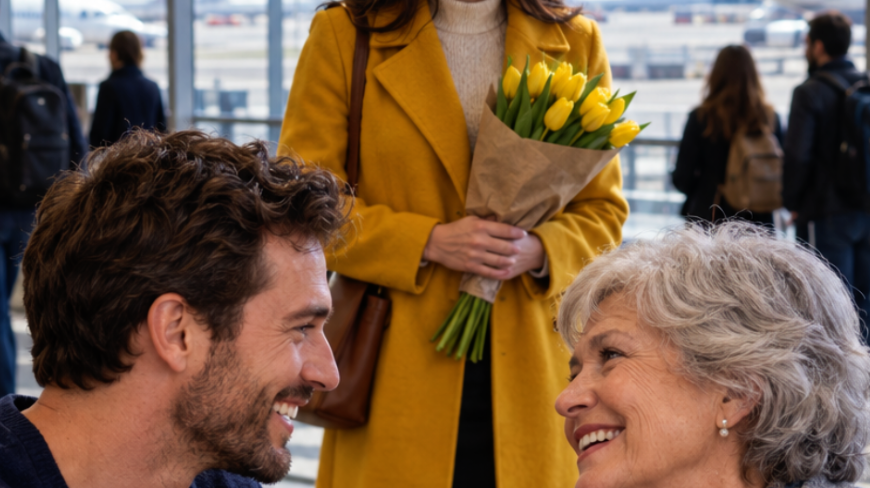
For the first time in sixteen years, Vera decided to surprise her husband by meeting him when he returned from a business trip. She arrived at the airport an hour early and spotted him in a café. He was holding hands with a gray-haired woman and laughing in a way she hadn’t seen him laugh at home for a long time.
Vera was an hour early to the airport because she was always early. Whether it was the train station, a doctor’s appointment, parent-teacher meetings, or even her own wedding, she was always there ahead of time. This time, the extra hour would cost her sixteen years of marriage, but as she parked on the third level, she had no idea what was coming.
But the morning had started out like any other.
The kitchen smelled of dough and fried onions. Vera, wearing an old flannel robe with a missing button at the waist, stood at the stove making dumplings, lining them up carefully on a board—eight in each row. Gleb loved lamb dumplings. He always said that during business trips, all he ate was buckwheat and cafeteria meat patties, so every time he returned, Vera made sure there was some homemade meal waiting for him. That was just the way things were done. Vera had always set up these little rituals and kept track of everything.
A note was pinned to the fridge with a magnet shaped like a little airplane. In her handwriting, small and pressed hard: “Flight 18:40. Koltsovo. Taxi by yourself.” And below, in a slightly different colored pen: “Shirts in the closet, don’t take the blue one.”
“Mom, why are you making so many?” Sonya entered the kitchen wearing headphones, one pushed down to her neck. “Dad is just one person.”
“Dad is hungry.”
“Dad’s an adult. He can make dumplings himself. From a pack.”
“He won’t eat ones from a pack.”
Sonya opened the fridge and stared inside for a long time, as if it were showing a movie, then closed it without taking anything out. She was sixteen years old, one meter sixty-eight—three centimeters taller than her mother—and proud of it. Her hair was dyed ash blonde, but at the roots her natural chestnut was growing back.
“He didn’t even eat last time,” her daughter said. “He just came in, said ‘thanks, Vera,’ and went to bed.”
“He was tired.”
“He’s always tired.”
Vera didn’t reply. The flour on her fingers had dried and tightened her skin, so she rubbed her hands together, shaking the white flecks onto the board. Sixteen years. Gleb had been going on business trips for the last nine, two weeks each month, sometimes three. As an equipment installation engineer for bakeries: Novosibirsk, Moscow, Perm, Tyumen. He came back looking gray, smelling of airplane coffee and strange hotels, kissed her on the temple, set his bag down in the hallway, and went straight to shower. He was in there a long time. Sometimes up to forty minutes.
She kept count. She kept track of everything.
“Listen,” Vera wiped her hands on a towel. “What if I go meet him?”
Sonya took out her other earbud.
“What do you mean?”
“I mean, I’ll go to the airport. With flowers. Like in the movies.”
“Mom, you haven’t met him at the airport once in sixteen years.”
“Exactly.”
Her daughter gave her a thoughtful, almost grown-up look, and Vera suddenly felt uncomfortable, as if she’d been caught doing something wrong. But what? Wanting to do something nice for her own husband?
“He doesn’t like surprises,” Sonya said.
“How do you know?”
“He told you. Remember when you booked a restaurant for his fortieth birthday and he wanted to go fishing instead?”
Vera remembered that restaurant. Twelve guests, a cake with a number on it, heartfelt toasts. Gleb smiled all evening, and on the drive home, he turned to her and said, “Thank you, Ver. I mean it.” Then he stayed quiet all the way back. She thought at the time that he was just touched.
“He showed those photos to everyone for a whole month after,” Vera said.
“You were the one showing them off,” Sonya corrected her. “He just happened to be standing there next to you.”
By lunchtime, the dumplings were packed away in the freezer—three bags, each carefully labeled with marker. Vera took a shower, dried her shoulder-length dark chestnut hair, and spent ages deciding what to wear. The mustard-colored coat she’d bought last spring, only worn twice, seemed right. Gleb had said it was bright. She still didn’t know if that was a compliment or not.
At the flower shop by the metro, the air was thick with the smell of damp earth and chrysanthemums. The saleswoman, wearing a green apron, asked her:
“Who are they for?”
“My husband.”
“Your husband,” the saleswoman repeated with a smile. “That’s rare to hear. Usually it’s the other way around—husbands buying for their wives.”
“He’s coming home from a business trip.”
“In that case, tulips. Yellow ones. Men don’t like roses; they feel awkward holding them.”
Vera took nine yellow tulips. Their stems were cold and squeaked as the saleswoman wrapped them in kraft paper. Vera held the bouquet as if she was balancing a cake, walking carefully to her car, afraid to spill it.
The app on her phone showed: the flight from Moscow, on time, landing at 18:40. She set out at 16:50. The drive should take about forty minutes, fifty just to be safe. But Vera knew herself: she’d much rather wait at the arrivals board than show up at the last minute, out of breath and flustered.
Trucks rumbled along the Koltsovsky highway. The sky was low and March-grey, with a yellow band on the horizon. The car smelled of tulips and a hint of gasoline. Hanging from the mirror was a keychain she’d put there herself five years ago: a tiny icon and an amber bead.
And the whole way, Vera rehearsed.
She imagined Gleb coming out from behind the sliding doors—tired, duffel slung over his shoulder, wearing his grey jacket with the worn left cuff. She pictured him spotting her, watching his face change. What would he say? “Ver, what are you doing here?” Or maybe nothing—maybe he’d just hug her. He hadn’t hugged her in a way she remembered in a long time.
The arrivals hall was bright and echoing. It smelled of coffee, wet shoes, and something sweet from the bakery. Vera glanced up at the clock above the board: 17:38. Exactly an hour until landing—unless the flight came in early.
She walked along the arrivals board and found her flight: “Moscow. 18:40. On time.” Right above it was another line: “Moscow. 16:05. Arrived.”
She paid no attention to that flight. Why would she?
People were lined up behind the barrier, holding signs. A woman in a puffy jacket carried a boy about four years old, who was gnawing on a ring-shaped roll. Two men in overalls argued about a freight wagon. Vera put her bag down by her feet, adjusted the bouquet, and realized she wanted a coffee. Not because she was tired—she just needed something to do with her hands.
The café was just to the right of the exit, behind a low glass divider covered with fake ivy. Wooden tables, pastries under glass domes, the scent of cinnamon. Vera stepped up to the counter, opened her wallet, and looked up.
At the far table by the window, Gleb was sitting.
At first, she didn’t believe it. A man in a blue sweater, with short hair just starting to gray at the temples, broad shoulders, and a slight slouch—there are plenty like him. But then he turned his head, and she saw the scar above his right eyebrow, a thin white line about a centimeter long, the one he’d gotten at nineteen when he fell off his bike. She’d kissed that scar the first night they ever spent together.
Gleb laughed.
It wasn’t the way he laughed at home, watching a show with Sonya. Not polite, not just a small chuckle from the corner of his mouth. He laughed with his whole body, leaning back in the chair, covering his eyes with his hand like people do when something is so funny it almost makes them cry. Vera hadn’t seen that gesture in ten years. Maybe more.
There was a woman sitting across from him.
She was older. Much older. Her gray braid, thick and almost reaching her waist, was tied with a black hairband. She wore a gray knit cardigan and her hands were thin. Vera could barely see her face; the woman was sitting half-turned toward the window.
And Gleb was holding her hand.
He covered her hand with his own and didn’t let go. With his thumb, he traced slow circles over her knuckles, back and forth.
“Miss, what would you like?” the barista asked.
Vera didn’t answer. Her fingers clenched the bouquet’s paper so tightly it crinkled loudly.
“Miss?”
“Nothing. Thank you.”
She stepped behind a pillar. Her back pressed against the cold marble. Her heart wasn’t aching, nothing like that, no—it just suddenly became hard to swallow, like her mouth had gone dry all at once. Vera swallowed. Then swallowed again.
He landed on the 16:05 flight. He’s been sitting there for an hour and a half. With her.
Who is she?
Theories lined up in her mind, quickly and neatly, like dumplings on a tray. A coworker? What kind of coworker is over sixty? A fellow traveler? You don’t hold hands with fellow travelers. A lover? The woman could be his mother.
Vera peeked out from behind the pillar.
The gray-haired woman was speaking, using her hands to help express herself. Gleb listened with his chin in his fist, nodding along. There were two paper cups and a plate with pastries on the table. One pastry had a bite taken out of it. Gleb only ate the ones with cabbage. Only cabbage. Vera had spent twelve years baking him meat ones before he finally said that, actually, he didn’t really like the meat ones.
She took out her phone. Her hands weren’t cooperating—she had to tap the contacts icon twice before it opened.
The call rang once. Then twice. Behind the glass, Gleb glanced down at his pocket, pulled out his phone, checked the screen. His face changed instantly. His shoulders tensed, his back straightened, the smile vanished like water seeping into sand.
“Yes, Vera.”
“Hi. Where are you?”
“At Domodedovo. Sitting at my gate. Boarding will be called soon.”
Vera watched him from across the hall. He was sitting twenty meters away, his back to the window, while someone else’s plane landed outside.
“No delays?” she asked.
“Looks like there aren’t any. Why are you calling?”
“No reason. I made dumplings.”
“With lamb?”
“With lamb.”
“Thank you, Vera. Okay, they’re calling boarding, I have to go.”
He put his phone down, face-down. The gray-haired woman said something, he shook his head and rubbed the bridge of his nose with two fingers. Then he took her hand again.
Vera headed for the exit.
Not quickly. Calmly, so as not to draw attention. The tulips grew heavy in her hand, and just as she neared the doors, she noticed a trash can and stopped over it, but couldn’t let go. So she carried the bouquet out to the parking lot, to the wind, and left it on the back seat, like putting down something that didn’t really belong to her.
At home, Sonya was sitting on her bedroom windowsill, legs tucked beneath her.
“Well?” she called across the hallway. “Did you meet her?”
“The flight’s delayed.”
“And the flowers?”
“They’re in the car.”
Vera walked into the kitchen and switched on the kettle. She stood there, watching the first bubbles appear on the side. She filled a glass with tap water, brought it to her lips, then set it back down without taking a sip.
Why did she leave? She should have gone over. Sat down next to him, put the bouquet on the table, said hello and watched what he would do next. Any normal woman would have gone over.
But she couldn’t. Her legs just wouldn’t move. Something inside her knew: if she went over, she’d have to hear his answer.
At 8:25 PM, the lock in the hallway clicked. Vera jumped so much that her spoon clinked against the saucer.
“I’m home,” Gleb said.
He came in smelling of the street and a hint of cinnamon. He set his bag on the bench, hung up his jacket, and kissed Vera on the temple. It was dry, habitual.
“How was your flight?” she asked.
“Okay. It got bumpy over Kazan.”
“Was it very rough?”
“Manageable.”
She watched as he washed his hands at the kitchen sink, even though the bathroom had one too. He always washed his hands in the kitchen. For a long time, with soap, all the way up to his elbows, like a surgeon.
“I’ll cook some dumplings,” Vera said.
“No need, Vera. I ate on the plane.”
“But it’s just the usual chicken and rice there.”
“Yeah, chicken and rice.”
He lied so easily her jaw clenched. Cabbage pies. Cinnamon. A gray braid.
“Sonya was asking about you,” she said.
“I’ll go see her now.”
And he went to their daughter. Vera listened from the hallway as they talked. Sonya was laughing, and Gleb was telling a story about a fellow passenger who was so scared he held onto the flight attendant’s sleeve the entire trip. That passenger. That flight attendant. He was making it up as he went, and he was good at it.
She took a bag of dumplings from the freezer, looked at her handwritten label: “lamb, 48 pcs,” and put it back in.
That night, Gleb slept on his back, his arm flung over his head. Vera lay beside him, listening to him breathe. Even, deep breaths. Can a person who lies really sleep like that? She’d always thought liars slept poorly.
His bag was in the hallway. She knew it was there, even without seeing it. The zipper on the side pocket, the one he always used for documents.
Don’t, Vera told herself. That’s too low.
At 2:40 AM, she got up, threw on her robe, and headed to the hallway.
The boarding pass was in the side pocket, folded in quarters. Vera unfolded it under the kitchen light. “Moscow. Yekaterinburg. Departure 12:20.” Not an evening flight. Afternoon.
Under the boarding pass she found something else. A small clear bag, a dried sprig of lavender tied with thread inside, and a folded note on lined paper. Vera unfolded it. Large, careful handwriting, a loop on the letter “d”: “Glebushka, this time don’t forget your blood pressure pills. I’ll check. F.”
F.
She read the note three times. Glebushka. Only as a child would anyone call him that. His mother, probably. Vera wasn’t sure. She had only met his mother a few times, long ago, and afterwards things ended in such a way that she didn’t want to remember.
There was also an old receipt, some paperclips, and a café slip from the airport in the pocket. Two Americanos, four cabbage pies. Date. Time: 16:32.
Then Vera did something she’d never done before. She took his phone from the hallway table where it was charging. She knew his password: Sonya’s birthday. He hadn’t changed it.
There were three contacts under ‘F’. Fyodor Sergeevich, the head of the workshop in Tyumen. ‘Window Company’ with the master’s number. And just ‘F.’ No last name. With a number starting with nine hundred and eight.
There were no messages with ‘F.’ None at all. Not a single text. Only calls. Vera scrolled through the call log: every week, sometimes twice. On Sundays, always at the same time—7 a.m.—when she was still asleep. Calls lasted twenty minutes. Sometimes forty.
She put the phone back in its place, screen down, just as it was before. She stood in the dark. The fridge was humming in the kitchen, water gurgled somewhere in the neighbors’ pipes.
What are you doing, Vera? Checking your husband’s pockets at night. Like you’re in some cheap soap opera.
But her hand still remembered the little lavender sachet. The dry stems pricked through the plastic.
She went back to bed and spent the rest of the night staring at the ceiling, where a yellow square from the streetlight lay. The square slowly faded. By six, it was gone completely.
In the morning, Gleb made coffee himself. He rarely got out the Turkish coffee pot, said he found it too much hassle.
“What’s with you today?” he asked, setting the cup in front of her.
“What do you mean?”
“You look pale.”
“Didn’t sleep well.”
“Blood pressure again?”
“I don’t have blood pressure problems, Gleb. You’re the one with that.”
He lifted his brow with the scar.
“Where’d you get that idea?”
“You take pills.”
“What pills?”
Just like that. Calmly, no pause. Vera stirred her coffee, even though she hadn’t put any sugar in it.
“Never mind,” she said. “I must have imagined it.”
“You imagine a lot of things.”
He said it without any anger, almost cheerfully, and turned to the window. Outside, in the courtyard, the janitor in an orange vest was knocking icicles off the porch canopy with a long pole. The icicles crashed down and shattered with a clatter.
Vera watched her husband’s back.
When did he become like this? Or was he always this way, and she just didn’t see it? She’d known everything about him for sixteen years. What toothpaste he liked, how he salted his soup, why he refused to eat meat pies. No, she only learned about the pies after twelve years. How many more things were like those pies?
After breakfast, Gleb went to the office to submit a report. Vera was left alone. Sonya left for school, slamming the door so hard a scarf fell from the coat rack.
Vera called her friend.
Lida worked as a senior nurse at the clinic and spoke as if she were jotting notes into a patient file: short, to the point, with a diagnosis at the end.
“So. Gray hair, you said?”
“Gray. Her braid went down to her waist.”
“About how old?”
“Close to seventy. Maybe a bit less.”
“I see. And he was holding her hand?”
“He was, Lida.”
“Well, I don’t know. Maybe she’s a client. Maybe from some charity. Men go to charities to help out these days.”
“People don’t spend forty minutes talking to clients on the phone at seven in the morning.”
Lida was silent for a moment. Vera could hear someone knocking at her office door on the other end.
“Vera. Just don’t work yourself up. Find out first.”
“How?”
“The way everyone does. Ask him directly.”
“And if he lies?”
“He’s already lied. It won’t get worse.”
“It will, Lida. It will if he tells the truth.”
Her friend didn’t answer. Then she sighed:
“Alright, I have a waiting room full here. I’ll call you this evening. Hang in there.”
Vera set her phone down on the table. It lay there, screen up and silent.
Gleb’s next business trip was in eleven days. Perm. Vera knew this because she was the one who wrote it in the calendar on the fridge.
For those eleven days, she lived like she was walking on a tight wire. Mornings, she made breakfast. During the day, she worked from home, handling the accounting for three small firms, and the numbers in the spreadsheets always added up just like they always did. Evenings meant dinner, TV, and conversations about nothing.
Gleb seemed like his old self. Or had she just forgotten what he used to be like?
She started to notice. How he checked his phone on Sunday mornings, stepping out to the balcony wearing only socks, even though it was five below outside. How he lingered in the shower. How, when she asked, “Do you love me?” he’d answer, “Vera, what kind of question is that,” which wasn’t a yes or a no.
One day, she asked him:
— Gleb, when was the last time you thought about your mother?
He was cutting bread. The knife stopped midway through the loaf.
— Why are you asking?
— No reason. Sonya was asking about her grandmother. They’re making a family tree for school.
— Tell Sonya her grandmother’s gone.
— She’s not gone, Gleb. She’s alive somewhere.
He set the knife down. Carefully, blade toward the wall.
— Vera. You said it yourself back then: her or us. Remember?
— I remember.
— Exactly.
He walked out of the kitchen, leaving the bread half-sliced. The crust was jutting out to the side.
Vera remembered. Of course she did. Their wedding, the café on Malysheva, fifty guests. Gleb’s mother, Faina, showed up drunk. Red-haired, wearing purple lipstick, her dress shimmery with lurex. She sang at first, then cried, then started an argument with Vera’s mom about who loved whom more. By the end of the night, an envelope with money, thirty thousand from Vera’s aunt, vanished from the gift box. They found the envelope in Faina’s bag. She screamed that she never took it, that she was being set up, that Vera was a snake.
After that there were two more years. Late-night phone calls. Asking for money. Showing up at the hospital after Sonya was born, with a bottle in a bag. And that’s when Vera said: her or us. She said it, just the two of them, in the hospital hallway, holding her newborn daughter.
Gleb chose them.
He stopped visiting his mother. Didn’t call, at least not when Vera was around. Never mentioned her. Vera thought this had set him free. She truly believed it.
And now: the gray braid. “Glebushka.” The letter “F.”
No. It couldn’t be. That Faina was loud, red-haired, with purple lips and a raspy laugh. The woman at the airport was sitting quietly, in a gray cardigan, her hands thin and almost transparent.
People don’t change like that.
Or do they?
The day of the business trip, Gleb was flying out in the morning at 7:15. Vera woke up with him, made sandwiches, and packed them in a container. He watched all this with a strange look on his face.
— Why aren’t you asleep?
— I just can’t sleep.
— Vera, are you okay?
— Are you?
He paused in the doorway. Bag on his shoulder, jacket unzipped. Vera saw his Adam’s apple twitch.
— I’m fine, he said. — I’ll be back Wednesday.
— What time’s your flight?
— The evening one. Around seven. I’ll text you.
— Text me.
He left. Vera closed the door behind him and leaned her forehead against it. The metal felt cold.
Evening. Around seven.
She opened the airline’s website and checked the schedule. There were two flights out of Perm on Wednesday. One at 19:10, and the other at 14:30.
On Wednesday, Vera headed to the airport by 1:30 PM. She didn’t bring any flowers.
She arrived early and took a seat at a café, choosing a table by the column so she could see the entire hall and the far corner by the window. She ordered thyme tea. The barista—a young woman, the same one from last time—looked at her and seemed to recognize her.
At 2:15 PM, a gray-haired woman walked into the café.
Vera noticed her immediately. A braid, a gray cardigan, this time over a dark blue dress. In her hands— a fabric bag embroidered with a sunflower. The woman walked to the far table by the window, sat down, and took a small thermos out of her bag. Then, two porcelain cups with a blue rim. She set them on the table, one opposite the other.
The barista called out to her from behind the counter:
“Faina Arkadyevna, the usual for you?”
“The usual, Irochka. Two with cabbage. And one with cherry, he deserves something sweet today.”
Her voice was low and a bit hoarse. Vera recognized it instantly, and her stomach twisted. Not even the voice, really—more the intonation. The drawn-out “swe-e-eet” sounded just like it did sixteen years ago, at the wedding, when she raised a toast for the newlyweds.
Faina Arkadyevna. Her mother-in-law.
Vera watched her and couldn’t look away. Where was the red hair? The lipstick? The woman now was lean, upright, with a narrow face deeply lined around the mouth. No makeup. On her left hand, a simple, thin and worn wedding band. A watch with a leather strap on her wrist. She sat staring out the window at the runway, her lips moving just slightly. Was she praying? Counting?
At 2:40 PM, they announced boarding for the Perm flight.
At 3:05 PM, Gleb walked into the café.
Faina stood up to greet him. He hugged her tightly, bending down since he was a head taller. She murmured something into his shoulder and patted his back. Then she pulled away, cupped his face in her hands, and looked him over, turning it gently from side to side the way you check on a child after an illness.
“You’ve lost weight,” she said. Vera heard every word. “Not eating again.”
“I eat, mom.”
“Did you bring your pills?”
“I did.”
“Show me.”
He reached into his pocket and pulled out a blister pack. Faina took it, counted the empty slots, and nodded.
“Good job. Sit down.”
They both sat. She poured from the thermos for him. Steam rose above the blue-rimmed cup.
Vera sat behind the column, her thyme tea cooling in front of her. Her hands lay on her lap. She couldn’t feel them.
Mom.
He said “mom” so simply, as if he said it every week. And maybe he did. On Sundays. At seven in the morning. For forty minutes.
How many years? How many years has he been sitting in this café, flying in on the afternoon flight to spend three hours with his mother, then returning home to a wife who makes dumplings and labels the bags with a marker?
Vera sat and listened.
“How’s Sonechka?” Faina asked.
“She’s growing. Dyed her hair—some kind of gray.”
“Ash-blond, that’s in style. Show me a photo.”
He pulled out his phone and scrolled. Faina looked, holding the screen away from her eyes the way farsighted people do. She studied the photo for a long time. Then she traced her finger across the screen, over her granddaughter’s face, and handed the phone back.
“She looks like you. Your chin.”
“She looks like Vera.”
“She looks like Vera, too. Her eyes. So serious.”
Gleb stayed silent and broke off a piece of pastry.
“How’s Vera?” his mother asked.
“She’s fine.”
“Gleb.”
“What?”
“I’m asking how Vera is. Not about the weather.”
He put the pastry down, rubbing the bridge of his nose with two fingers, just like last time.
“I don’t know, Mom. She senses something. She looks at me strangely. Yesterday, she asked me about the pills.”
“Maybe it’s time?”
“No.”
“Twelve years, son. You’ve been behind her back for twelve years.”
“Mom, we’ve talked about this.”
“We have. And I’ll still say it. You’re not lying to her, you’re lying to yourself. She’s buried her mother-in-law a long time ago. But you—you live in two homes, and both are just an airport away.”
Gleb laughed, short and without joy.
“Like you said. An airport away.”
“How could I put it any other way? You come here to me like it’s a retreat. Sit, warm up, and then back there again, to your dumplings.”
“Mom. Let’s not talk about dumplings.”
“I won’t. Sorry.”
She placed her hand over his. He didn’t move it away.
Vera stood up. The chair scraped against the tiles, catching the attention of barista Ira. Faina Arkadievna also looked up at the sound, instinctively.
And their eyes met.
Faina recognized her instantly. Vera saw the recognition: her mother-in-law’s eyes widened slightly, the hand on her son’s tightened, lips parted. But the older woman said nothing. Not a word. She just stared, unblinking, and then, very slowly, withdrew her hand from the table.
Gleb noticed his mother looking past him and began to turn around.
Vera left the café before he could catch a glimpse of her face.
Parking lot, third level. Concrete, the scent of exhaust and dampness. Vera sat in her car with both hands on the steering wheel, not starting the engine.
Twelve years.
She counted in her head, like she always did. Sonya is sixteen. Twelve years ago, her daughter was four. That was the year Gleb started his new job and began going on business trips. The year he suddenly seemed calmer, stopped blowing up over small things, and got quiet at dinner. That was the year she thought he had finally grown up.
He hadn’t grown up. He’d found his mother.
Or had his mother found him?
Vera took wet wipes out of the glove compartment, wiped her face even though it was dry. The wipe smelled like aloe. She crumpled it in her fist.
A call. Gleb.
She watched as the screen lit up, then went dark. Lit up again. Third time. Fourth.
On the fifth ring, she picked up.
“Vera. Where are you?”
“In the parking lot.”
“Which one?”
“Right below you. Third level.”
Pause. She could hear the noise of the terminal through the phone, an announcement for the Sochi flight.
“I’ll come to you,” Gleb said.
“Don’t.”
“Ver.”
“I said, don’t. Stay with her. Finish your tea from the thermos. You’re not in a rush—you have a flight at seven-something tonight.”
He was silent. Then he asked:
“How long have you known?”
“Two weeks.”
“And you said nothing.”
“And you said nothing for twelve years, Gleb. I still have a long way to go to catch up.”
She ended the call and started the engine.
She drove home slowly, staying in the right lane and letting everyone pass. Trucks sped by, splashing her windshield with dirty water, and the wipers couldn’t keep up. Vera peered through the grime, her mind on those blue-rimmed cups. Two porcelain cups. Not the kind you buy for a random meeting. You carry them in a cloth bag, wrapping them in a towel each time so they don’t break. For years.
Sonya sat in the kitchen eating dumplings. Right out of the pot, with a fork.
“Mom, I cooked them myself,” she said, her mouth full. “Where were you?”
“Out running errands.”
“Dad called. Like, five times. He said if you came home, I should tell you he’ll be here soon.”
“But he’s supposed to come in the evening.”
“I don’t know. He just said soon.”
Vera took off her coat. Mustard yellow, bright. She hung it on the hook and spent a long time fixing the collar.
“Sonya. Do you remember Grandma? Dad’s mom?”
Her daughter stopped chewing.
“No. How would I? You always said she left when I was little.”
“That’s what I said.”
“But what really happened?”
Vera sat down across from her. She grabbed a fork from the drawer, speared a dumpling from the pot, and took a bite. Lamb, onion, pepper. Just like always, good. Or maybe too good—too perfect, too by-the-book?
“The truth is, I made her leave,” Vera said. “Out of our lives. When you were born.”
Sonya put down her fork.
“Why?”
“She drank. A lot. She stole money at our wedding. She came to the hospital drunk when you were born.”
“Oh,” her daughter said. She was quiet for a moment. “Well, that makes sense.”
“It does?”
“Yeah. I probably would have too.”
Vera looked at her daughter. Sixteen years old, ash-colored hair, serious eyes. Her eyes. Faina had said: serious.
“She doesn’t drink anymore, Sonya. Hasn’t, for a long time.”
“How do you know?”
“I saw her today.”
“Where?”
“At the airport. With Dad.”
Sonya was silent for a long time. Then she got up, walked to the window, and pressed her forehead to the glass just like she used to as a child, waiting for Dad to come home from a work trip.
“So he keeps in touch with her?” her daughter asked, not turning around.
“For twelve years.”
“And you didn’t know?”
“I had no idea.”
“No way,” said Sonya. Then she burst out laughing—short, confused. “Mom. Listen. He’s been hiding from you with his own mom for twelve years. Like a teenager. Like me when I sneak off to the movies with Dania.”
“This isn’t funny, Sonya.”
“It’s not funny,” her daughter agreed. She turned around. “Mom. Why was he hiding?”
Vera didn’t answer.
Because she had said: it’s either her or us. Because she never asked. Because in their house, everything was stuck to the fridge, labeled with a marker and pressed with magnets, and there was no space on that sheet for a mother who’d quit drinking.
Gleb arrived at 5:20 PM, by taxi. Vera heard the car door slam downstairs, heard him taking the stairs instead of waiting for the elevator. Heavy, quick steps.
He came in and stopped in the hallway. Didn’t take off his jacket. Bag still in hand.
Sonya peeked out of her room and shut the door right away. The lock clicked.
“Vera,” he said.
“Come in. Wash your hands.”
He went to the kitchen and washed his hands at the sink. For a long time. Up to his elbows. Vera watched his back and for the first time wondered: Why does he wash so thoroughly? What is he cleaning off?
Gleb dried his hands with a towel and sat at the table. Across from her. Just like Faina had sat across from him in that cafe.
“I don’t know where to begin,” he said.
“Start at the beginning.”
— She got a call from the hospital. It was twelve years ago. She’d fallen outside in the winter, had some heart trouble. The only number in her phone was mine. So I went. I was sure it was the same as always—drunk again, asking for money again. But there she was, sober. For the first time in my life, really sober. She said, ‘Glebushka, I haven’t drunk in two years. Sorry for calling you. There’s just no one else.’
Vera listened quietly. Her fingers found the edge of the tablecloth and started folding it back and forth, back and forth.
— I didn’t want to lie to you, — Gleb said. — I wanted to tell you right away. But I came home, and you were with Sonya. Sonya had caught chickenpox. You hadn’t slept for three days. So I thought: later. I’ll tell you later, when Sonya gets better. Later, when you’re not so tired. Later.
— Twelve years later.
— Yes.
— And the business trips?
— The business trips were real. I just always took the earliest flights. I’d arrive three hours early. She got a job at the airport as a cleaner, then in the cloakroom, now she works in luggage storage. She lives here, in the village, fifteen minutes by bus. It’s more convenient for her. And for me.
— More convenient for you, — Vera repeated.
He looked up at her. His gray eyes were red at the edges.
— Vera. It made me feel calmer, not more convenient. Do you understand? I would arrive, spend three hours with her, and no one there would check on me. No one asked if I brought the blue shirt. No one kept track of how long I spent in the shower.
Vera let go of the edge of the tablecloth.
— Is that what you think of me?
— That’s how I think of myself. I’m a coward. I was afraid of you.
— Afraid of me?
— Of you. That you’d say: her or us. Again. And I’d have to choose again.
The kitchen fell silent. The fridge clicked and hummed. In Sonya’s room, music played softly—only the bass wandered through the wall.
Vera stood up and walked to the fridge. There was a note held by a little airplane magnet: ‘Flight 18:40. Koltsovo. Take a taxi yourself.’ And below: ‘Shirts are in the closet, don’t take the blue one.’
— Why don’t you like the blue shirt? — she asked, not turning around.
— What?
— I wrote: don’t take the blue one. Why? I don’t even remember why I wrote it.
— You said it made me look older.
— But do you like it?
Gleb was silent for a moment.
— I do. My mother gave it to me.
Vera took the note off the fridge. The magnet fell, hit the tile, and one of the airplane’s wings broke off. She didn’t pick it up.
— When are you flying to her again? — she asked.
— I don’t know. I didn’t think that after today…
— When, Gleb?
— She calls next Sunday. Like always.
— And when will you see each other?
— I have Tyumen in three weeks. I’ll be driving, not flying.
— So you’ll go specially. On Sunday. To the airport.
He looked at her, not understanding.
— Vera, what are you talking about?
— I mean, I will go with you.
But there were still six days until Sunday. And every one of those days, Vera lived as if she stepped on ice that kept cracking under her feet but never broke.
Gleb moved carefully around the apartment. He washed his cup right after finishing his tea. He kept asking if she needed anything from the store. Once he brought her tulips—yellow ones, nine of them. Vera placed them in a vase and remembered the ones left on the back seat of the car. They must’ve dried by now. The paper had turned yellow.
On Wednesday night, she woke up and realized he wasn’t by her side. She found him on the balcony, standing in just his socks on the cold floor, smoking. He had quit smoking eight years ago.
“Gleb.”
“Can’t sleep.”
“Me neither.”
She stood next to him. The yard below was dark, with only a single lamp above the entrance, and tiny snowflakes twirling in its light.
“Do you really want to go?” he asked.
“I don’t know.”
“Then why did you say you did?”
“Because if I don’t go, you’ll keep going there for another twelve years. And I’ll be making dumplings and labeling freezer bags. And we’ll both pretend this is what life is supposed to be.”
Gleb exhaled smoke away from her.
“She’s afraid of you,” he said.
“Who?”
“Mom. She told me when she saw you at the café: ‘Glebushka, she looked at me just like back at the hospital.'”
Vera remembered. The maternity ward hallway, the smell of chlorine, a bundle in her arms. The red-haired woman with a bag, a bottle clinking inside. And her own voice: Get out. Get. I never want to see you again.
“I was right back then,” Vera said.
“You were.”
“And now?”
He put out the cigarette on the railing. Sparks flew down and faded in the snow.
“Now I don’t know, Vera. Now, all three of us are wrong.”
Lida called on Thursday. Vera told her everything, sitting on the bathroom floor, because it was the only place where no one could overhear from the other room.
“So,” her friend said. “So, not a mistress.”
“Not a mistress.”
“His mother.”
“His mother.”
“Listen, that’s wonderful, Vera. Honestly, it’s the best possible outcome. I’ll be straight with you, I was already thinking of finding you a lawyer.”
“Wonderful,” Vera repeated. “My husband hid his own mother from me for twelve years because he was afraid of me. That’s wonderful.”
“Well. Okay. But why was he afraid?”
Vera was silent for a moment.
“Because he had a reason, Lida.”
Her friend didn’t say anything. Some device beeped on the line, and someone called her by name.
“Vera. Are you going to go?”
“Yes, I will.”
“Take something with you. You can’t go empty-handed to your mother-in-law. Not even to one like this.”
On Saturday evening, Vera was making pastries.
Not dumplings. Pastries with cabbage. She found the recipe in her mother’s old notebook—the one with the oilcloth cover and greasy marks on the pages. She stewed the cabbage for a long time with onions and carrots, until it turned golden and sweet. She kneaded the dough by hand, and flour got stuck under her nails.
Sonya came in, drawn by the aroma.
“Who are these for?”
“For grandma. And dad.”
“Aren’t you making any with meat?”
“Dad doesn’t like meat ones.”
Her daughter sat on a stool, pulling her knees to her chest.
“Mom. Can I come, too?”
Vera paused. Her hands were dusted with flour, half a pastry lay on the board.
“Do you want to go?”
“I don’t know. Just to see. She’s my grandma, after all.”
“Sonya. She might not be the way you imagine.”
“How do I imagine her?”
“I don’t know. Kind. Like in storybooks.”
“Mom, I’m sixteen. I don’t think grandmas are like storybooks. Honestly, I don’t picture her any particular way. I never had her.”
Vera closed up the pastry, pinching the edges. Her fingers worked on their own. She’d made pastries at twenty, at thirty, at forty. She never imagined making them for Faina.
“Next time,” she said. “First, I go. Okay?”
Sonya nodded. She took one of the first batch of cooling pastries and took a bite.
“They’re delicious,” she said. “Even better with cabbage.”
Sunday was sunny—the very first like it all March. The snow piled along the sides of the Koltsovsky highway had turned black and was sinking down, puddles reflecting the sky, bright and vast.
Gleb was driving. Vera sat beside him, a container of pies wrapped in a towel on her lap. Still warm.
“Does she know I’m coming?” she asked.
“She knows. I told her this morning.”
“What did she say?”
Gleb eased up on the gas as he approached the turn.
“Nothing, really. She was quiet, then said, okay. Then she asked what you’d be wearing. Wanted to know.”
“She’d recognize me anyway.”
“She said last time she recognized you out of fear. But this time she wants it to be different, to do it properly.”
Vera wore a mustard-colored coat. When Gleb saw her that morning in the hallway, he hadn’t said a word, just smiled a little. He wore a blue shirt.
The arrivals hall smelled like coffee and wet shoes—just like that first time. People stood by the rails. A boy, about five, sat on a suitcase, legs swinging. The arrivals board was flashing.
Vera checked her watch: 1:20 PM. They’d arranged to meet at half past one.
“We’re early,” Gleb said.
“I’m always early.”
“I know.”
They walked to the café. Behind the counter, barista Ira saw them together, raised her eyebrows, then smiled—shyly, for some reason—and said:
“Faina Arkadyevna’s already here. She’s been here since twelve.”
Since twelve. An hour and a half before their meeting.
Faina sat at a far table by the window. Her hair in a braid, a gray cardigan, a blue dress. On the table: a thermos, and not two but three cups edged with blue. The third cup, slightly chipped, sat apart—as if it had been taken out at the last minute and they hadn’t decided where to put it.
Her mother-in-law saw them and stood up—too quickly, the chair rocked. She grabbed the backrest and stayed standing, unsure what to do with her hands. Then she laced her fingers tightly together in front of her.
Vera walked over. Stopped one step away.
They looked at one another. Up close, Faina looked even thinner than she’d seemed. Her cheekbones taut, skin thin with tiny red veins. Light-gray eyes, just like Gleb’s. And a small, old scar on her chin.
“Hello, Faina Arkadyevna,” Vera said.
“Hello, Verochka.” Her voice trembled slightly on the name. “Sit down. Both of you. I made some tea. Mint tea. I don’t know if you drink mint tea.”
“I do.”
“Good. Good.”
They sat. Gleb between them, off to the side, like a referee. He was silent. Vera noticed his knee moving under the table.
Faina poured tea into the three cups. Her hands trembled a bit, and the stream from the thermos spilled onto the saucer. She wiped it with a napkin.
Vera unwrapped the towel and set the container of pies on the table.
“Here. With cabbage.”
Faina gazed at the pies—a long time—then looked at Vera.
“Did you bake them yourself?”
“I did.”
“He won’t eat them with meat.”
“I know. I know now.”
Her mother-in-law took one pie, broke it open. Steam rose from the cabbage. She took a bite, chewed, and closed her eyes.
“They’re good,” she said. “Soft. I could never get them this soft. I always overworked the dough.”
They fell silent. Outside, a tug was moving across the runway, towing a plane with a blue tail.
“Verochka,” Faina said quietly. “I need to tell you something. Please, don’t interrupt, okay? I’ve been building up to this for twelve years, and I’ll probably mess it up.”
“Go ahead,” Vera replied.
“I was the one who took the money at the wedding. Me. Nobody set me up. I screamed that I didn’t do it, but I did. I needed it for booze—my hands were shaking so badly. I even showed up to the maternity ward drunk. And you were right to kick me out. Absolutely right.”
Vera looked at her. Her fingers touched the rim of her saucer and stopped still.
“I’m not going to thank you for that,” Faina went on. “But I do need to thank you for something else. After you threw me out, I was so ashamed that for the first time, I just couldn’t drink. I poured myself a glass, but I couldn’t touch it. I just sat there, staring into the drink, seeing your face. And little Sonechka, just a glimpse of her in her swaddling—her little cheek. I couldn’t do it. I slipped up for a couple more years, but after that… that was it.”
She put her half-eaten pastry down on a napkin.
“Back then, in the hospital, I told Glebushka not to tell you. That was me. I asked him. He didn’t decide that on his own. I was just scared you’d kick me out again, and I couldn’t handle that a second time. I wouldn’t survive it again.”
Gleb lifted his head.
“Mom, you don’t—”
“Hush, son. I know I’m not getting it all right. But it’s like this too.”
Vera sat holding the cup in both hands. The tea was hot and smelled of mint. The water trembled at the edge and Vera couldn’t figure out why, since nobody was topping it off. Then she realized—it was her hands shaking, making the tea ripple.
She set her cup down.
“Faina Arkadyevna.”
“Yes?”
“I want to tell you something too. I’ll probably say it all wrong as well.”
Her mother-in-law nodded and squeezed her fingers together.
“I spent twelve years thinking everything was just right between Gleb and me,” Vera said. “Everything in order. Shirts, flights, dumplings. And for twelve years, he came here to you to get a break from all that order. That’s what I saw. Not you—him. The way he laughs here. He never laughs like that at home. Never.”
Gleb dropped his gaze.
“And I don’t know what to do about it,” Vera confessed. “Honestly. I just don’t know. I don’t know any other way—my mother taught me to keep everything under control, everything counted. Otherwise, it all falls apart.”
Faina reached her hand across the table, thin and marked by a worn, delicate ring. She stopped, hovering above Vera’s, not quite touching.
“May I?” she asked.
Vera didn’t reply. But she didn’t pull her hand away.
Her mother-in-law covered Vera’s hand with her own. Her skin was dry and cool, rough on the fingertips. She smelled of laundry soap and lavender.
“It will fall apart,” Faina said. “Something always falls apart. For me, everything did—my husband, my home, my son. After that, I started working here, in the left-luggage room. People hand in their suitcases—packed to the brim, strapped tight—and walk away unburdened. They breathe out. And I think: maybe that’s what we all need. Just for a few hours.”
She grew quiet.
“He wasn’t running away from you when he came to me. He was running towards a little lightness.”
Vera looked at her husband. Gleb sat with red eyes, lips tight, his hand pressed to his forehead, shielding his eyes. Just like that first day he laughed—but now, he wasn’t laughing.
“Gleb,” she said.
“Yes?”
“Take off your watch.”
“What?”
“Take off your watch. You keep checking it every five minutes. There’s no flight to catch. We’re not in a rush.”
He glanced at his wrist, unfastened the strap, and set his watch face down on the table, right next to the thermos.
Suddenly, Faina laughed—softly, with a raspy sound. She covered her mouth with her hand.
“What is it, Mom?”
“Nothing. She’s just like me. When you were a child, I used to say the same thing: Take off your watch, don’t rush. But you always kept looking anyway. You’d look at the wall, or at my watch.”
They stayed in the café until five o’clock. Barista Ira brought them two more cherry pies—on the house—and mentioned that Faina Arkadyevna had sat at this very table every Sunday for twelve years. Even when Gleb didn’t fly in, she’d still come, sit with her thermos, and watch the planes.
“Why?” Vera asked after Ira walked away.
Her mother-in-law’s thin shoulders moved beneath her cardigan. She shrugged and immediately let them fall, almost as if embarrassed by the gesture.
“Habit. It’s miserable to be alone at home. Here, there are people. Arriving, leaving. Someone always meets them. I watch how people meet each other—some come with flowers, some with children. Some just run up, arms wide open.”
“Did anyone ever meet you? Ever?”
Faina thought for a moment.
“No,” she said. “No one ever met me. I was always by myself.”
Vera glanced at Gleb. He was looking out the window. The airplane with the blue tail—the same one being towed earlier—was now speeding down the runway. Faster and faster. It lifted off.
On the way back, Vera asked:
“Where does she live? Exactly?”
“In the settlement. On Bakhchivandzhi, past the post office. Two-story barrack, second floor.”
“By herself?”
“With a cat. An orange one. She says he looks like how she used to be.”
Vera looked out the window at the black snow along the roadside. Underneath, the earth was starting to show through.
“Gleb, who comes to her birthday?”
“No one. I just call her.”
“When is her birthday?”
“April twentieth.”
“That’s soon.”
“Yes.”
Vera was silent for a while. Then she took her phone from her bag and opened the calendar. She found April twentieth and stared at the empty square for a long time.
She didn’t write anything down.
At home, she put the kettle on and took three mugs from the cupboard. She looked at them, put one back, then took it out again. Sonya stood in the doorway watching this fuss.
“Mom. So?”
“It’s fine.”
“It’s fine,” her daughter mimicked. “Mom. How is she?”
Vera poured the boiling water. Steam rose up and settled in drops on her wrist.
“She’s thin,” Vera said. “Her braid is down to her waist. Her hands are cold. She laughs like your father.”
“What did she say?”
“She said I was right to send her away.”
Sonya raised her eyebrows.
“Seriously?”
“Seriously.”
“And what did you do?”
Vera set the kettle back on its stand.
“I gave her the leftover pies. In a container. She said she’d finish them at work tomorrow.”
Sonya came over, grabbed the last pie Vera had set aside for her, and took a bite.
“I want to see her too,” she said. “Not next time. Soon.”
“Her birthday is on April twentieth.”
“That’s a Sunday, right?”
Vera didn’t know. She looked at the calendar on the fridge. Where a paper used to hang on a plane-shaped magnet, now there was an empty spot—just a rectangle, a bit lighter than the rest of the fridge door. The magnet with its broken wing was on the shelf by the stove, where she’d put it, never throwing it away.
“Sunday,” she said.
On April 20th, Vera woke up at six. Gleb was still asleep, lying on his back with his arm tucked behind his head. She quietly got up, slipped on her robe, and headed to the kitchen.
A new note was hanging on the fridge. It was her handwriting, small letters pressed down hard. But there were fewer lines than usual.
“Koltsovo. The window café. Blue shirt.”
She turned on the oven. Cabbage, stewed the night before, sat under a lid in the pot. The dough was rising in a bowl, covered by a towel, giving off a warm, sour scent.
Sonya came into the kitchen in her pajamas, hair messy and no longer ashy. She had dyed her grown-out chestnut back to its original color.
“What time are we leaving?” she asked.
“At twelve.”
“And when’s the meeting?”
“At two.”
“Mom. That’s two extra hours.”
“I know.”
Sonya yawned, sat on the stool, and pulled her knees up.
“Grandma will get there early anyway,” she said. “Dad said she’s been sitting there since morning.”
“That’s exactly why we’ll go early.”
Her daughter looked at her seriously, like an adult, with her grey eyes. Then she nodded and went to get dressed.
Vera took the dough out of the bowl. It felt soft and alive, sticking to her fingers. She rolled it out, cut circles with a glass, added cabbage, and pinched the edges. Her hands worked automatically, quick and steady.
There was a magnet on the shelf by the stove with a broken wing.
Vera picked it up, dusted it in flour, and stuck it to the fridge—right on top of the new note, covering the word “Koltsovo.” The little airplane hung on at an angle, with just one wing, but it stayed put.
In the hallway, Gleb was already ironing his blue shirt. She could hear the hiss of the iron and his humming something unfamiliar and light under his breath.
Vera checked the clock. Six forty. There was still a lifetime until noon.
She could have arrived two hours early. But this time, it wasn’t to catch someone.
This time, they were waiting for her.