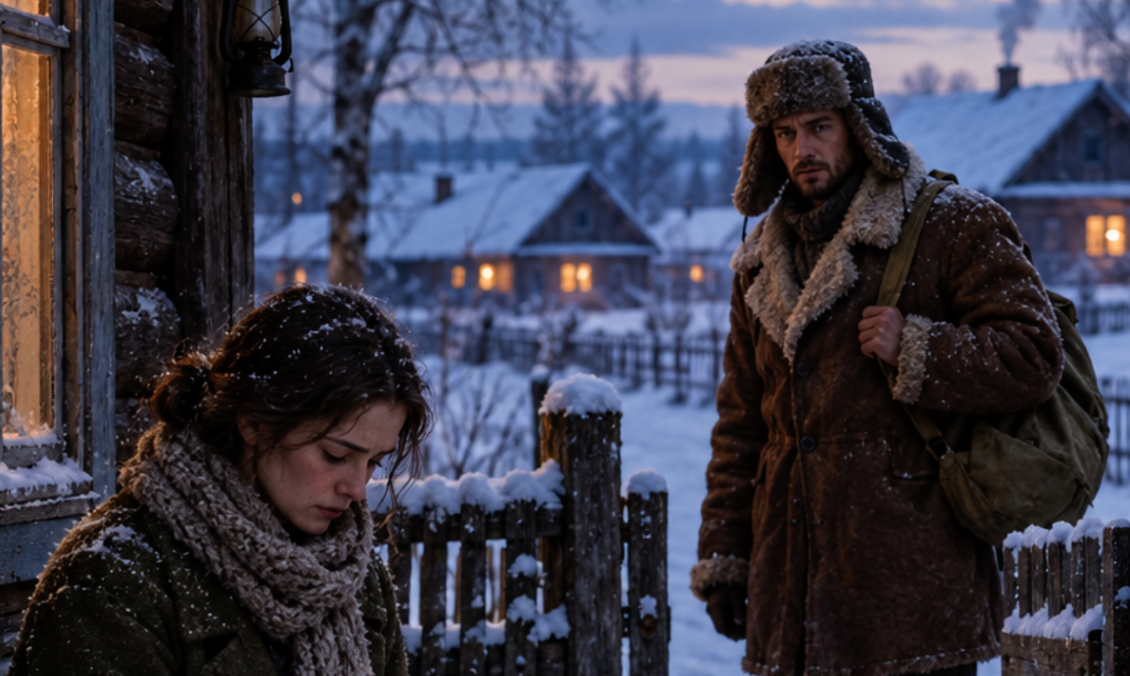
Nina became a widow at thirty-four.
Her husband, Sergey, died in a logging accident—the tree fell the wrong way. She was left alone. With two kids. With a house that was falling apart. With a vegetable garden that no one could tend. With a cow that no one could feed. With a pile of debts no one would pay.
The kids—Vanya, twelve, and Tanya, nine—were still just children. Not much help. Vanya tried—he chopped wood and hauled water. But he was too small. And Tanya, still just a little girl, would cry at night. She called out for her daddy.
Nina held herself together. She worked at the farm as a milkmaid. Woke up at four in the morning. Came home at eight in the evening. No days off. Her hands were covered in cracks. Her back was always aching. Her eyes were dull. But she kept the house. Fed the children. And never once cried in front of others.
In the village, people pitied her. But no one helped. Everyone had their own farms. Their own worries. Someone else’s widow isn’t family. They’d sigh, “Poor Ninka. How will she manage alone? She’ll be lost for sure.” And move on.
But she didn’t give up. Day after day. Month after month. Year after year.
By the second year, things got really bad.
The roof started leaking. The shed was falling apart. The firewood ran out in January, just as the temperature dropped to nearly minus forty. She burned old fence boards in the stove—the last ones. After that—nothing. Empty. Not a splinter, not a log left. She went out to the woodpile—buried in snow, empty. She stood there. Tried to break apart an old coal box—couldn’t do it. Her hands were frozen. She had no strength left. And she sat right down in the snow and cried. For the first time in two years. Loudly. Out loud.
Then, from over the fence, a voice called out:
“Hey, ma’am! What’s wrong?”
She raised her head. There was a man standing at the gate. A stranger. Tall. Thin. Wearing an old quilted jacket. Rubber boots. A duffel bag slung over his shoulder. Looked about forty. His face was dark, weather-beaten. But his eyes—his eyes were bright. Unexpectedly bright for that rugged face. Like the sky breaking through clouds.
“Nothing,” she said. “I’m just out of firewood.”
“No firewood? That’s not so bad. Firewood, you can always get,” he said with a smile. His teeth were strong. His smile was good. Kind. “Listen, ma’am. I’m looking for work. Maybe you need help around the place? I can fix the fence. Patch the roof. I know how to do everything.”
“Who are you?”
“Viktor. From far away. I’m a worker. A carpenter. I do metalwork too.”
“Where are you living?”
“Nowhere, for now. I just arrived.”
Nina looked at him. His duffel bag. His hands—large, calloused, covered with scars. She thought for a moment. Then she said:
“I’ve got a summer kitchen that’s empty. There’s a stove in there. A bed. You can stay. Help out around the house—for thanks. And food, as we can provide.”
He nodded.
“Deal.”
And the first thing he did was grab an axe. By evening, a pile of chopped wood stood by the porch. Nina looked at it—she couldn’t believe it. The stove was humming again. The house smelled warm. The kids slept without waking from the cold. For the first time in a week.
The next day, the whole village knew: Ninka the fool had let some drifter into her home.
“What are you doing, Nina?” her neighbor, Aunt Zina, came running. “Are you out of your mind? Who is he? Where’s he from? What if he’s a criminal? What if he’s a thief? What if he hurts your children? Did you think about your kids?”
“I thought about it,” Nina said. “He fixed the fence. He got firewood.”
“What do you know! He’ll rob you and disappear! Or even worse!”
Aunt Zina spat in disgust and left. That evening, another neighbor came to see Nina. Then another. Then the chairman of the village council showed up. Everyone said the same thing: “Throw him out. Who knows what might happen if he stays.”
Nina listened and nodded to each visitor. But in the evening, she poured Viktor a cup of tea and asked him:
“Where are you from, really?”
“From far away,” he would reply. And nothing more.
A month went by. Then a second. A third.
Viktor worked. A lot. Silently. From early morning until dark. He fixed the roof—no more leaks. Repaired the shed—the cow gave a relieved sigh. Fixed the fence—no more snow drifting into the yard. He dug out a cellar. Repaired the porch. Turned over the garden soil. Chopped up stakes. Even fixed up the well.
At first, the children were scared of him. They clung to their mother. But eventually, they got used to him. Vanya started following Viktor everywhere, watching how he handled the axe. Viktor showed him how to hold it, how to swing, how to sharpen the blade. Tanya brought him tea. He would take the mug, nod, and say, “Thank you, young hostess.” She would run off, blushing and happy.
Nina watched all of this, and she felt something inside her begin to thaw.
One evening, she asked:
“Viktor, why are you alone? Don’t you have a family?”
He was silent for a long time. Then he replied:
“I did. I had a wife. A daughter. In the city. Long ago. Haven’t seen them in a while.”
“Why not?”
He looked her in the eyes. Calm and steady. And said:
“I was in prison, Nina. Ten years. I was released six months ago.”
She froze. Ten years. That’s a serious sentence. No one gets away with that lightly.
“What for?”
“A fight. Manslaughter by negligence. I was protecting my wife from someone… That’s how it turned out. My wife didn’t wait for me. My daughter either. They left. Don’t know where.”
He stopped talking. She was silent too.
Then she asked:
“Why didn’t you tell me from the start?”
“Would you have let me stay if I had?”
She thought for a moment.
“I don’t know.”
“That’s why.”
They sat together in the kitchen. The small lamp glowed. The firewood crackled in the stove. It was quiet. Warm.
“The children are asleep,” Nina said.
“They are,” he replied.
“You… you’re not going to hurt them, are you?”
He looked at her for a long time, his gaze serious.
“I have a daughter too, Nina. Somewhere out there. She’s like your Tanya, only older now. I’d sooner cut off my own hand than harm a child. Please… don’t be afraid.”
And she wasn’t afraid.
By the fifth month, the whole village was buzzing with gossip.
Somebody found something out. Saw some paperwork. Or heard talk. And then it all started to spread.
“Did you hear? Nina’s tenant—he’s been in prison!”
“Ten years! Murder!”
“She leaves her kids with him!”
“What a fool!”
“He’ll cut them up at night and set the house on fire!”
“You should call the police!”
“What’s the point? He’s free now. He served his time—he’s ‘clean.’”
“Clean! As if! They’re all ‘clean’ like that.”
People whispered behind Nina’s back. In the store, they turned away. On the farm, they gave her dirty looks. One day, Aunt Zina couldn’t stand it any longer. She approached Nina out in the street and said loudly, so everyone could hear:
“Nina, you’ve lost all shame! Took a man into your home! And what kind of man! A criminal! Don’t you feel sorry for your kids? Aren’t you ashamed in front of your late husband? You should at least consider his memory!”
Nina stopped. Turned around. And spoke softly, but loud enough for everyone to hear:
“Remembering my husband isn’t about tears. Remembering him means having a warm home and children who are well-fed. Got it? Or do I need to explain it again?”
And she walked away.
Aunt Zina just stood there, her mouth wide open.
Winter passed. Then spring. Then summer.
Viktor found a job as a carpenter at the collective farm. He was earning money and bringing it home. At first, Nina refused to take it:
“You don’t have to. You’re already working. For nothing.”
“Silly,” he said calmly. “The kids need things. Shoes. Clothes. For school. Take it.”
She took it. And she cried. For the first time, not out of sorrow. But because someone cared. Someone was thinking about her. About the kids. About their home.
That autumn, they got officially married. Quietly, without a wedding. They just went to the village office, signed the papers, and that was it.
The village gossiped a little more, then settled down. There was nothing more to say. What’s done is done. They live—let them live. Things like this happen.
A year later, they had a son. They named him Sergey, after her late husband. Nina wanted it that way. Viktor didn’t argue.
It’s evening. Winter. Frost outside.
Around the table sits Vanya—now fifteen, a strong boy who takes after his real father. Tanya—twelve, a beauty with a braid down to her waist. And little Sergey, three years old, playing on the floor with a wooden tractor Viktor made.
Nina sets dinner on the table. Viktor comes in from outside—covered in snow and frost. He takes off his padded jacket, washes his hands, and sits down at the table.
“So, how was your day?”
“It was fine. The cow’s been milked. I chopped some firewood.”
“I could have done it myself.”
“I know. But you’re tired. Come on, sit down. Eat.”
She sits. Serves him some porridge. He takes his spoon. Eats. Says nothing.
“Vitya,” she says.
“Yeah?”
“Tell me… When you first came over then… why? Why did you come to me?”
He chews. Thinks. Then says:
“You were sitting in the snow, crying. I saw—a young, beautiful woman sobbing over an empty woodpile. I thought—this can’t be right. Such a woman—alone. And no firewood. That’s just not right.”
“That’s all?”
“That’s all.”
“And the village… what people said about you… you knew they’d talk, right?”
“I did. I’m used to it, Nina. I spent ten years in prison. They said far worse about me there. But I know my own worth. And you do too. As for the rest…”—he waved his hand—”Wind. Here today, gone tomorrow.”
She looks at him. At his light eyes. At his hands. At his face—now not dark anymore, just normal. Calm.
“I’ve never once regretted it,” she says. “Not once. Even when everyone was yelling.”
“I know.”
“What about you? Do you regret it?”
He puts down his spoon. Looks at her. For a long time. Seriously.
“Nina. I waited ten years. Didn’t even know what for. I was just waiting. And then I came here. Saw you. Saw you crying over an empty woodpile. And realized—this is it. It was all worth it. All of it. The sentence. The paperwork. This village. Everything.”
She is silent. Her eyes are wet.
“And you know what?” he says. “If they asked me now: want to do it all over again? I’d say yes. Just to come to you. To your fence. To find you sitting in the snow and crying. And for me to say: ‘Hey, miss! What’s wrong?’ And you’d answer…”
“Out of firewood,” she says. And laughs through her tears.
“Exactly,” he says. “Out of firewood. Thanks to that empty woodpile.”
She laughs. He smiles. The kids watch them, not understanding. And little Sergey lifts his head from the tractor:
“Mom, what’s wrong?”
“Nothing, sweetheart. I’m just happy.”
“Why are you happy?”
“We’re alive,” Nina says. “We’re just living.”
This is how they live. Year after year. Winter after winter. The house stands strong—Viktor rebuilt it log by log. The roof never leaks. The fence is sturdy. Firewood has never run out again—Viktor always prepares enough for two winters ahead. Their woodpile rises by the fence like a fortress wall. Solid. Well taken care of.
Sometimes Nina remembers: how she once sat in the snow, crying over the empty woodpile. How she walked across the whole village under whispers and sideways glances. She thinks: I could have been scared. I could have listened to Aunt Zina. I could have kicked him out. And then what? I would have lived alone. Struggled with the house. Cried at night. But now—things are different. Now—there’s a family.
And she wonders: what makes a person? Is it a passport? A certificate? Rumors? Gossip? Or is it hands? Deeds? Actions? The fence that hasn’t fallen? The roof that doesn’t leak? The children who have full bellies?
Everyone decides for themselves. She made her choice.
And she chose right