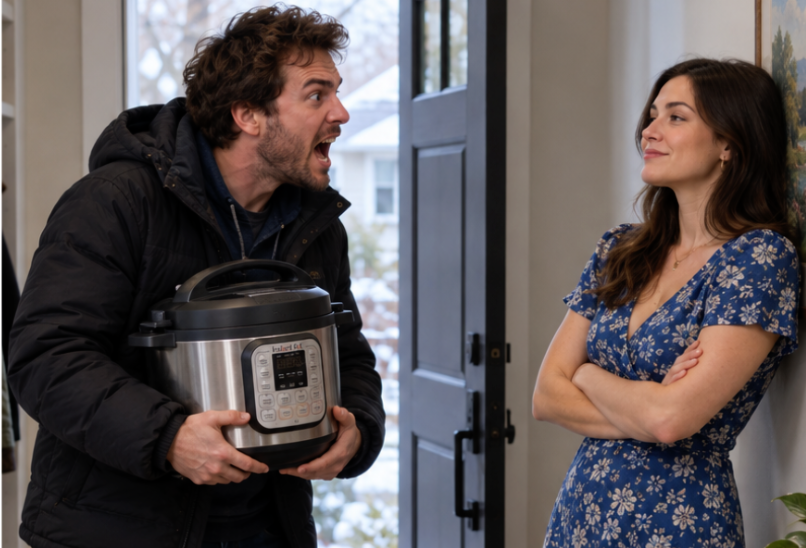
Stas was pulling a suitcase down from the top shelf, and dust was falling straight into the pot of soup.
“Lida, let’s not make a scene,” my husband said. “I’m leaving.”
“Then at least don’t sprinkle dust on the soup,” I replied, covering the pot with a lid. “Where are you going, if you don’t mind me asking?”
He set the suitcase on the stool and flipped open the lid. His movements were rehearsed, as if he’d been playing out this evening in his head all week.
“To Ilona. Remember the one who hosted Zhanna’s birthday?”
I remembered. The yellow coat, the microphone, and the voice that made his sister’s shot glasses rattle in the cabinet.
“You’re a good person, Lid,” Stas said. “But you’re too domestic. It’s boring with you. You’re a cook; even your life has a menu: cutlets on Wednesdays, floors on Saturdays, New Year’s cards for relatives. Who sends cards anymore? You’re the only one left in the whole post office.”
“You send cards if you have someone to send them to,” I said. “So, with Ilona, every day is exciting, right?”
“With her, every day is a celebration.”
“Of course. She gets paid for making it a celebration.”
He didn’t smile. He rarely laughed at my words, but he’d howl with laughter at jokes on TV.
Stas folded his shirts the way he always did, sleeves tucked in. Razor, chargers, folder with car documents from the hallway drawer. Then he came into the kitchen, unplugged the multicooker, and hugged it to his chest like a cat.
“I want to really live, you know? Not just have borscht by the schedule.”
“Looks like you’re taking the scheduled borscht with you,” I said.
Stas looked at the multicooker and then at me.
“I bought this.”
“With my card.”
“Here we go. Are you really upset about that?”
“I’m just curious,” I said. “What else are you taking from the boring life you want to leave behind?”
He pretended not to hear and put the multicooker into the suitcase, right on top of the shirts. He had to use his knee to close the zipper.
In the hallway, he was already pulling on his shoes when he turned around.
“By the way, the car loan we took—it’s on you. You’re responsible; you never miss a payment.”
“Wait a second,” I said. “The car is in your name, but the loan is in mine?”
“We registered it to you. You said yourself your credit history was clean.”
“Four hundred twenty thousand, Stas. That’s how much is left.”
“So what? You have a job. I can’t show up to Ilona’s empty-handed. That would be awkward.”
“You’ve got the multicooker,” I said.
He waved dismissively, like waving off a fly, and reached for the doorknob.
“Just don’t turn off my phone yet—it gets paid from your card. I’ll change it over later.”
That “later” was the last straw. I grabbed my phone from the table, opened my banking app, and right there in front of him, calmly turned off all the automatic payments. His phone. Internet in the garage. The football subscription I’d been paying for three years, never having watched a single match.
“What are you doing?” Stas asked.
“Getting you ready for real life,” I said. “Key on the table.”
“Come on, Lida, that’s petty.”
“Petty? Taking the multicooker is petty. Key.”
He dropped the key on the table, and it slid right onto the floor. Stas didn’t pick it up.
“You’ll regret this,” he called from the stairs. “Who would want someone like you with your cutlets?”
“Me,” I said, and closed the door.
I had picked up the key myself. Three days later, Zhanna messaged me: “I’ll bring Timka on Saturday as usual. You’re not going to drag the kid into your drama, are you?”
***
On the last Saturday of April, Zhanna dropped Timur off around nine and got stuck lingering in the hallway.
The wallpaper in the corridor was gone. I had spent all of March peeling it off, one strip a night. I painted the kitchen mustard yellow—a shade so bright that my downstairs neighbor actually asked if I was opening a café.
“What’s all this?” Zhanna asked.
“Renovation. After February, I needed something to do with my hands,” I replied.
Stas and I officially divorced in early April—ten minutes at the registry office. We spent longer waiting in line than actually signing the papers.
Timur darted past his mother straight to the kitchen and the frying pan. He’s nine, and he truly believes cutlets are the best thing adults have ever invented.
Zhanna pulled off one boot and paused, eyeing my head. Short haircut, ash blonde. The stylist spent three hours on it.
“You dyed your hair, too,” she said. “How much did you pay?”
“Nine thousand.”
“Nine thousand just for your hair?” Zhanna stood balanced on one foot. “You’ve got a loan hanging over you, and you’re off to beauty salons.”
“I only have one head,” I said. “And, unfortunately, one loan too.”
“That’s why he left,” Zhanna said. “You have to hold on to a man, Lida. You should’ve dyed your hair when he was still around. But you tried to keep him with your cutlets.”
“I didn’t keep him on a leash,” I said. “And I don’t dye my hair for him.”
“Then for who? At forty-seven?”
“For myself.”
Zhanna pulled off her second boot, walked into the kitchen, poured herself tea from my kettle, and sat on the stool where Stas’s suitcase had stood back in February.
“Here’s the deal. I’ll leave Timka with you till tomorrow. Oleg and I are heading to the resort. And you’ll sew curtains for my dacha—I brought the fabric in the car. You’ve got your evenings free now anyway.”
“Leave Timur, he doesn’t bother me,” I said. “Sew your own curtains. And bring back my sewing machine. You borrowed it in October for a week.”
“What machine? You gave it to me.”
“I lent it for a week. The week was up in October.”
“Oh, Lida, what do you need it for now? There’s no one left to sew for.”
“And the money you borrowed for Timka’s teeth—did I give that to you too?” I asked.
“That’s different, come on. That was for the kid. You’re his aunt, after all. We’re family.”
“We were,” I replied.
I didn’t get a receipt back then. Who asks for one from their husband’s sister when a child’s tooth hurts in the middle of the night?
Zhanna finished her tea and then seemed to remember why she’d really lingered.
“By the way, Stas asked me to remind you not to forget about the car. Otherwise, the bank will start calling him since he’s listed as your contact person. He can’t be stressed right now. Ilona got him a new leather jacket, and they’re heading to Sochi.”
“Tell him I pay every tenth,” I said. “I bake pies for custom orders in the evenings to cover it. A homemaker doesn’t abandon her debts—or other people’s, for that matter, as it turns out.”
“Please, don’t even start,” Zhanna said. “You let him slip through your fingers.”
Already in the hallway, pulling on her boots, she grabbed my new umbrella from the rack—a dark blue one with a wooden handle, bought back in March along with my hair dye.
“I’ll take this; they said it’s going to rain. I’ll bring it back later.”
I took the umbrella out of her hands and hung it right back on the hook.
“You already have the car since October,” I reminded her. “The umbrella can stay here.”
“Why are you acting like this?” Zhanna stared at me as if I’d suddenly started stripping in front of her. “So stingy.”
“Just careful,” I replied.
At that moment, my phone started ringing in my pocket. It was an unfamiliar number with a different area code.
“Lidiya Sergeyevna Koltsova?” a woman’s voice asked, crystal clear and loud enough to fill the hallway. “This is notary Safina, from Kamyshlov. I’m calling regarding the estate of Arkady Ilyich Pestov.”
Arkady Ilyich was my mom’s second cousin. I’d only seen him twice in my life, both times as a child. Still, every December I sent him a card—first because it was on my mom’s list, and then just out of habit.
“Has he passed away?” I asked.
“At the beginning of March. You are mentioned in his will. You need to come in.”
Zhanna froze with one boot in her hand. Her eyes went wide, round as buttons.
“What kind of inheritance?” she whispered.
“Get your boots on, Zhanna,” I said. “You’ll be late to the base.”
***
I went to Kamyshlov in mid-May, taking the train and bringing a pie in a bag. I had no idea who I was about to meet, but I never show up empty-handed.
The notary turned out to be a petite woman with glasses on a chain. She accepted the pie without surprise and set it on her windowsill.
“Arkady Ilyich left you everything,” Rimma Akhatovna told me as she turned the papers toward me. “A first-floor property on Lenin Street that’s currently rented by a pharmacy. Two apartments, both leased out. And a bank account.”
I looked at the account balance and counted the zeros. Then I counted them again, not believing my eyes the first time.
“Why me?” I asked. “I’ve never even been to his place.”
Rimma Akhatovna pulled a shoe box wrapped in a pharmacy rubber band from her desk drawer.
“They found these in his cabinet. Your postcards. We got your address from the return address on them, and your phone number was in his address book. When he made the will, I asked how you were related. He said, ‘She’s the only one who wishes me Happy New Year. The rest will remember me when I’m gone.’”
On top was last year’s card—with a pine branch and a bullfinch. My handwriting, my awkward capital letters, wishing him a warm winter. ‘Who even writes postcards anymore?’ Stas had said back then. Well—me.
“We’ll take your application today,” the notary said. “You’ll get the certificate after September third, once six months have passed since his death. And keep in mind: this is your personal property. Your ex-husband gets nothing, even if you were still married.”
“And the car loan that’s in my name—does that count as my personal property too?” I asked.
Rimma Akhatovna took off her glasses, letting them dangle on their chain.
“Did you buy the car while married? Then you should file for division of property. Half the car is yours, and the debt gets split. These kinds of cases are common—the courts deal with them every day.”
I pictured the courthouse hallway, Stas in Ilona’s jacket, and myself trying to prove, in front of him, that I’m more than just someone who makes meatballs.
“I don’t want to ask him for anything,” I said. “Not even through a judge.”
The notary shrugged and put her glasses back on.
I got my certificate on September 9. A week later, during my lunch break—between the main course and dessert—I paid off the loan for Stas’s car in one go. The bank sent a message: “Your obligations are fulfilled.” I read it three times before getting back to the kitchen.
On the last Sunday of September, Zhanna showed up unannounced. She brought Timur and a store-bought cake—something she never did before.
“Well, spill it, heiress,” she said as soon as she stepped through the door. “The whole town is buzzing. Lida, you hit the jackpot—millions, houses, stores.”
“Who’s buzzing?” I asked.
“Everyone. Did you really think you could keep this under wraps? I searched your Pestov’s name online—he has a pharmacy and everything.”
Timur disappeared into the other room with his tablet. Zhanna sat in her usual spot by the window, moved the cake closer, and got straight to business.
“Oleg and I need to change our car. Now you can help us out—like family should.”
“Like family? You mean the way it was with the toy car and Timur’s teeth? Return the toy and pay for the dentist first, then we’ll talk.”
“Are you throwing that in my face?” Zhanna pushed the cake back. “You’ve got millions, and you’re counting pennies.”
“I do count. That’s exactly why your brother called me a homebody.”
“That’s why you’re sitting here alone,” Zhanna said. “You have to keep a man. But you wouldn’t even hold onto him with money, you’re just too stingy.”
“I have no reason to keep him,” I said. “Let Ilona take care of him.”
Zhanna stood up and took her jacket off the back of the chair.
“It’s fine. Stas will take what’s his. You lived together for twenty years—he gets half.”
“Inheritance isn’t divided, Zhanna. That’s what the notary told me, not some random thing you read online.”
“We’ll see who says what to whom.”
Timur peeked out of the room.
“Mom, is Uncle Stas sleeping on the cot again tonight? I can’t play my tank game in the kitchen because of him.”
Zhanna jerked as if she’d touched something hot.
“Go play.”
“What cot?” I asked.
“Aunt Ilona kicked him out,” Timur said, eyes glued to his tablet. “Back in August. With all his bags.”
Zhanna pressed her lips together until they turned white, then waved her hand like it was no big deal.
“It’s temporary,” she said. “He was planning to come to you anyway. Wanted to talk things over, like adults. So don’t be foolish, Lida. A man coming back on his own—happens once in a lifetime.”
“Are you returning your brother or just trying to clear your kitchen?” I asked.
Zhanna didn’t answer. She zipped up her jacket, called for Timur, and turned around at the door.
“So, you’re not giving us any money?”
“No,” I said. “Not for a car, not for a cot.”
“You’ve become so stingy. Money really does ruin people.”
“It wasn’t money that changed me,” I said, opening the door for her. “It was your family that taught me everything.”
That evening, I got a message from Stas. The first since February. “Lidus, we need to talk. I’ve realized a lot. Can I come by on Saturday?”
I stared at that “Lidus” for a long time. He hadn’t called me that in at least ten years.
“Come by for lunch,” I replied. Then I opened the bank’s website on my laptop, found the guarantor application form, and sent it to print. The printer started whirring, and I stood there smiling.
***
Stas showed up right at two on Saturday, a bundle of red roses in hand and wearing that same leather jacket. He’d lost weight. A fresh razor cut glowed on his cheek—the same razor he took with him in February, along with the rice cooker.
“Wow,” he said, glancing around the mustard-colored kitchen. “Lida, you’ve really changed.”
“Come in,” I said. “Put the flowers in the sink, I’ll get you a vase.”
He sat on his old stool and rubbed his hands together, like he used to before lunch.
“I was a fool, Lida. Honestly. That Ilona—just constant noise. Music from morning ‘til night, guests, toasts. On Wednesday I woke up thinking, ‘Lida’s making cutlets today.’ Can you believe it? I missed your cutlets.”
“Ilona kicked you out in August,” I said. “Is that why you started missing me?”
Stas twitched his cheek.
“Timka was talking nonsense. I left on my own. I figured out where my home is. Don’t think it’s about money.”
“What money?” I asked.
He wasn’t expecting that question and froze for a moment. Then he leaned across the table and started to speak in that voice he once used when he tried to persuade me to get a loan.
“I heard about the inheritance,” Stas said. “And I’m worried. People are going to swoop in. Some relatives might pop up, challenge it, tenants will try to take advantage. You’re a homebody, Lid, you don’t know about these things. But I can handle it.”
“You can handle it?” I asked.
“Of course. Here’s what we’ll do: you give me the documents and keys to the apartments. I’ll talk to the tenants, I’ll go myself, I’ll do all the paperwork. You won’t have to do anything at all. We’re family.”
Keys to the apartments. He didn’t even ask what city they were in.
“Glad you brought it up yourself,” I said. “Then I have a favor to ask.”
I pulled a blue folder out of the drawer. Inside were printouts I’d spent three evenings compiling, and a form still smelling of the printer. I sat across from him and sighed as heavily as I usually did over bills.
“There’s no fortune, Stas. Just a hole.”
“What do you mean?” he asked.
“The place under the pharmacy is pledged to the bank. Arkady Illich took out a loan against it for roof repairs and hasn’t paid for half a year. What was left from the deposit just barely covered overdue payments and penalties. The pharmacy’s moving out in November and demanding the advance rent back. One of the apartments has leaking pipes, and the neighbors downstairs are taking me to court. If I don’t pay the bank by November first, the place will be auctioned. That’s all the income.”
Stas pushed his stool away from the table.
“Then just give it up. Turn down the inheritance.”
“Too late,” I said. “I accepted it in May. The certificate’s in my hands. Now it’s all mine, including the debt.”
“So what do we do?”
“The bank is willing to refinance. But they won’t approve me alone; I’m just a cook in a school cafeteria. I need a guarantor with official income.” I slid him the form. “You said you’d handle it, right?”
Stas took the paper. I saw his eyes darting over the lines, stopping below where the fine print read: the guarantor is jointly responsible with the borrower.
“So wait, if you don’t pay, they come after me?” he asked.
“After us, Stas. We’re family,” I said. “And your car loan is still in my name—so we’ll deal with that together, too. You’ll live here, we’ll split the utility bills. I’ll bake pies, you bring the paycheck.”
“How much is there in total?” he asked.
“More than you’d earn in five years,” I replied.
The stool scraped against the tile. Stas stood up, and the form slipped off the table onto the floor.
“Are you out of your mind?” he yelled. “You’re dragging me into a debt trap? I knew it. You’ve always been a homebody, and you still are—only now you’re in debt too. Did you think I was stupid enough to sign?”
“But you promised you’d take care of it,” I said.
“Deal with your own mess. Some guarantor you found.”
He yanked his jacket off the rack and struggled to get his arm in the sleeve.
“And don’t call me again,” Stas said from the doorway. “And don’t bother Zhanna either—don’t fill her head with this stuff.”
At the door, he glanced back at the roses in the sink, but didn’t bother to come back for them. I took the bouquet out myself, shook off the water, and shoved it into his hands. He took it automatically, the way he always accepted anything handed to him.
He slammed the door so hard that the blue umbrella hanging on the hook swayed.
I stood there until I heard the entrance door slam downstairs. Then I went back to the kitchen, picked the form up off the floor and tore it in half, then in half again. My hands were warm and completely calm. Everything I needed to know about twenty years with this man fit onto a single sheet of fine print.
***
A month has passed. Zhanna is telling the whole family that I’m drowning in debt and tried to make Stas take responsibility for it. The aunts call her and express sympathy for their brother.
She doesn’t bring Timur over on Saturdays anymore. She still hasn’t returned the little car. Stas, they say, rented a room near the train station and is telling everyone how he got out just in time.
The pharmacy in Kamyshlov extended its lease for another three years. The October payment arrived right on time, on the fifth, as always.
Timur will turn ten in December. I’ve already bought him a construction set with a crane. I don’t know if Zhanna will actually give it to him if I bring it over.
In May, I’ll go to Kamyshlov to put up a new fence for Arkady Ilyich. While he was waiting for my postcards, I never managed to visit him.
I bought my New Year’s postcards back in October—a whole pack, decorated with fir branches.
On Wednesday, I made cutlets. Not because it was Wednesday, just because I felt like it. I ate them straight from the frying pan, standing by the mustard-colored wall, not rushing anywhere.