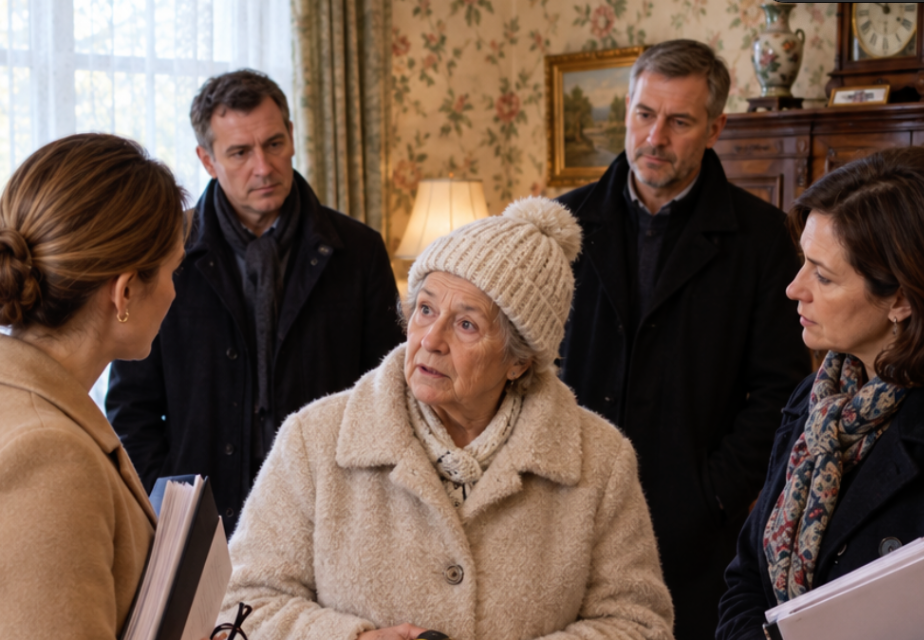
“Why are you home so early? You’re usually at work until seven,” my mother-in-law froze in the middle of the living room, holding a tape measure. The smile slipped from her face.
Polina stood in the doorway of her own apartment, unable to understand what was happening.
In her grandmother’s living room—where the air still held the scent of old books and apple jam—strangers were walking around. A young couple in matching gray puffer jackets. A woman with a tablet and bright red lipstick. And Lyudmila Arkadyevna. Wearing Polina’s slippers.
“Good evening,” Polina said. Her voice sounded distant, almost like she was speaking underwater. “Can someone explain to me what is going on?”
The woman with the tablet stepped forward and held out a business card.
“Zhanna, real estate agency. And you are…?”
“Me?” Polina even gave a short laugh. “I live here.”
“Ah, you’re a relative,” Zhanna nodded understandingly. “Don’t worry, the deal will be in three weeks. The owner gave us power of attorney, all the documents are in order. You’ll have time to pack up.”
The word “pack up” burned like boiling water.
“What owner?” Polina asked quietly. “I’m the owner of this apartment.”
The room went so silent that Polina could hear her grandmother’s clock ticking on the wall. The young couple exchanged glances. Zhanna turned her gaze to Lyudmila Arkadyevna.
And that’s when her mother-in-law did what she did best. She smiled. Softly, motherly, tilting her head just a little to the side.
“Polinochka, dear, why are you reacting like this?” Lyudmila Arkadyevna put the tape measure down and clapped her hands. “We’re just looking around. For everyone’s benefit. Stas knows, it was his idea. Don’t you remember, we talked about expanding?”
“I don’t remember,” Polina answered sharply. “I just remember that I didn’t invite anyone here.”
“See, she’s upset,” her mother-in-law sighed and turned to the buyers with an apologetic smile. “Please forgive her. She’s tired from work. My daughter-in-law is wonderful, just a bit nervous.”
“My daughter-in-law is wonderful.” Polina had heard that phrase for three years straight. At the wedding. At Stas’s birthday. To the neighbors. It always sounded warm to her. Now—it felt like someone scraped glass with a fingernail.
“Please leave,” Polina said to the buyers. Calmly, without shouting. “All of you. The apartment is not for sale.”
The couple left first—in a hurry, without saying goodbye. Zhanna lingered in the doorway.
“You should sort things out with your family,” she tossed over her shoulder, then corrected herself: “Well, among yourselves. But keep in mind, a deposit’s already been made.”
The door slammed shut.
Lyudmila Arkadyevna slowly took off the slippers and carefully placed them by the wall. She put on her own boots and zipped them up.
“You shouldn’t have done that, Polina,” she said now in a completely different tone: dry, even, without any trace of sugary sweetness. “They were good people. Good money. And once again, you ruined everything.”
And she left.
Polina sank onto a stool in the entryway. She glanced at her slippers by the wall. Inside, she felt empty and echoing—like a hollow bucket.
“A deposit’s already been made,” kept circling in her mind.
What deposit? For what? For her own home?
Stas came home just before ten. Usually, he’d call on his way to ask if he should pick up any bread. Today, he didn’t call.
He came in quietly, almost sneaking. Hung up his jacket. Spent a long time washing up… took forever in the bathroom. Then he showed up in the kitchen and sat across from me, eyes fixed on the table.
“Mom called,” he finally said.
“I figured as much.”
“Pol, you were too harsh. She just wanted the best for us.”
Polina slowly set her cup on the table.
“Stas. Strangers have been in my apartment with tape measures. The realtor said the deal is in three weeks. That the owner signed a power of attorney. What owner, Stas?”
He shifted uncomfortably in his chair. Scratched the bridge of his nose—the way he always did when he lied. Polina knew that gesture by heart, but had never put much thought into it before.
“Well… we talked about this. About getting something bigger. You said it was cramped.”
“I said it would be nice to have a separate room for the kids. Someday. I never said ‘sell grandma’s apartment.’”
“Nobody’s selling anything!” Stas raised his voice but immediately wilted. “Mom was just checking prices. To get an idea—that’s all.”
“What about the deposit?”
He said nothing.
Polina looked at her husband and suddenly remembered how it all began.
How Lyudmila Arkadyevna arrived with pies in the very first month after the wedding. How she hugged her, called her ‘daughter.’ How she sighed, eyeing grandma’s old wallpaper: “The apartment is quite old, of course. But it’s fine, we’ll figure something out.”
“We.” That word used to feel warm.
Then there were talks over tea. Careful, casual, slipped in between other things.
“I have a one-bedroom, you’ve got a two-bedroom. If we pool together, we can get a three-room place. Big and bright. For the whole family. The grandkids will need space to run!”
“But it would be better to put it in Stas’ name. He’s the man, the head of the family. No need for a woman to hassle with property—it’s safer this way. You never know.”
Polina would politely joke it off back then. She’d say grandma gave her the apartment as a gift, not to sell it. Her mother-in-law would nod, smile and stroke her hair: “Of course, of course, dear. I’m just saying.”
Just saying. For a whole year.
“Stas,” Polina said softly. “Look at me.”
He looked up. His eyes held everything—hurt, irritation, exhaustion. The only thing missing was surprise.
And then Polina understood. He wasn’t surprised. He knew.
“I’m going to bed,” Stas muttered and left the kitchen.
That night, she didn’t sleep. Lying on her back, staring at the ceiling, replaying the past few months in her mind. Where? When? What power of attorney?
And suddenly she remembered.
Three weeks ago. Stas picked her up from work in the middle of the day, all cheerful and busy.
“Pol, help me out. I need to transfer the car, so I need my wife’s notarized consent. Mom knows a notary, it’ll take ten minutes, tops.”
A tiny office on the edge of town. An older woman in glasses rattled off some text at light speed. At that moment, Polina’s phone kept ringing—her boss, a report due, looming deadlines. She nodded, not really listening. Stas stood beside her, holding her elbow and whispering, “Sign, sign, I’ve read it all.”
She signed. Two sheets. Without looking.
Because he was her husband. Because in a family, you trust.
Polina sat up on the bed. Stas slept facing the wall, breathing steady and calm. Like a man with a clear conscience.
By six in the morning, she was already standing at the bus stop.
Vera Nikolaevna always welcomed people in her old brick house by the park. She was the same notary who had handled Grandma’s gift deed three years ago. Polina remembered how her grandmother had said back then, “I trust Vera. She can see right through people.”
The notary listened to her in silence, not interrupting once. Then she turned to her computer and searched for something for quite a long time.
“Here it is,” she finally said. “A power of attorney from you to Stanislav Igorevich. It gives him the right to sell the apartment, receive the money, and sign all the documents. It was certified three weeks ago.”
Polina felt as if the ground had disappeared beneath her feet.
“I didn’t know what I was signing. They told me it was just consent to sell the car.”
“I understand,” Vera Nikolaevna took off her glasses and looked at her closely, with a kind of tired sympathy. “You’re not the first, Polina. If you only knew how many women have sat in that chair with the same look in their eyes.”
“What should I do?”
“Revoke it. Right now. A power of attorney can be canceled unilaterally; you don’t need the agent’s consent. I’ll record the revocation in the registry today. From this moment, nothing can be sold with it.”
Polina nodded. She was afraid to open her mouth—she felt that if she spoke, she would start crying.
“And another thing,” the notary continued. “Submit an application to the Rosreestr that any transactions with your apartment require your personal involvement. You can do this at the MFC, it’s free. That way, no piece of paper, no agent can do anything without you.”
“Thank you,” Polina exhaled.
“Don’t thank me.” Vera Nikolaevna put her glasses back on. “Do you know what your grandmother Zoya Ilinichna told me when she signed over the gift deed? ‘Verochka, I’m not just giving Polina the walls. I’m giving her security. So that no one can ever throw her out of her home.’”
Polina stepped outside and stood for a long time at the park fence. Wet snow was falling. People walked by with shopping bags, strollers, dogs.
She took out her phone and almost dialed Stas. She stopped herself.
No. Not yet—not to anyone.
That same day, she went to the MFC. She filed the application. She got a receipt. She placed both papers—the revocation of the power of attorney and the one from the MFC—into her grandmother’s pearl-lidded jewelry box.
In the evening, she made dinner as usual. Stas ate silently, glued to his phone. Polina watched him and felt nothing. No anger, no pain. Just a strange, ringing clarity.
Two days later, Oksana called.
Her sister-in-law rarely called Polina—only for holidays, with obligatory greetings. Stas’s older sister had long since moved to another city and barely spoke to their mother. Polina never understood why.
“Polya, hi. Are you alone? Can you talk?”
“I can.”
Oksana was silent for a moment. Then she exhaled, like someone preparing to jump into cold water.
“Listen. Maybe this isn’t my business, but mom called me yesterday. She sounded so pleased. Said soon all our problems would be solved, Stasik would sell the apartment, pay off the debts, and there’d still be enough left for a three-room place. What apartment, Polya? Stas doesn’t even have one.”
Polina closed her eyes.
“He does. It’s mine.”
“That’s what I thought,” Oksana said bitterly. “Pol, you should know. Mom has debts. Big ones. Last year she put money into some kind of ‘financial pyramid’ that her friend told her about. She took out loans, pawned everything she could. I refused to help her back then, and now she doesn’t speak to me.”
“What about Stas?”
“Stas has known since spring.” Oksana paused for a moment. “He complained to me himself in May. He said, ‘Mom cries, Mom can’t sleep, what do I do?’ I told him, ‘Let her sell her one-bedroom apartment.’ But he said, ‘Mom doesn’t want to; she’s lived there her whole life.’ So, they came up with this plan. Pol, I’m sorry. I should have called you sooner.”
“You called now,” Polina replied quietly. “Thank you, Oksan. Really.”
She hung up the phone and sat in silence for a long time.
Since spring. He knew since spring.
So all these months, when he brought her flowers for no reason, when he suddenly became attentive and gentle, when he hugged her before bed—it was all preparation. Kind, patient groundwork. So that, at the right moment, she would sign without looking.
Mama’s boy. Polina had heard that expression so many times. She never thought it applied to Stas. He was an adult, had a job, a car, his own opinion.
Turns out, he never had his own opinion. He always listened to his mother. It just used to be that her opinion matched Polina’s.
On Saturday, Lyudmila Arkadyevna came over herself. No call, as usual.
Standing at the door was her former mother-in-law—smiling, in a fluffy beret, holding a bag of homemade pies.
“Sweetheart, how long are you going to pout?” she kissed Polina on both cheeks. “I made you cabbage pies. You love cabbage pies.”
Polina stepped aside to let her into the kitchen. She silently put the kettle on.
Lyudmila Arkadyevna settled at the table, arranged the pies on a plate, and sighed.
“Polya, let’s do this nicely. Like family. I’m not your enemy. I’m your husband’s mother. We’re one family. And in a family, we help each other, right?”
“Right,” Polina agreed.
“See! I knew you were smart. You understand, Stasik is going through a tough time right now. He needs support. He needs a wife who believes in him. But you… you seem to be doing everything against him on purpose.”
“I’m not doing anything, Lyudmila Arkadyevna.”
“Exactly!” her mother-in-law leaned forward. “You’re not doing anything. But you need to. You need to think about the future. We’ll sell this old two-bedroom apartment, get a nice spacious new one. Stasik will be the man of the house, you’ll be the hostess. Starting a family. Wouldn’t that be great?”
“And your one-bedroom? Will we sell that too? All chip in, like you said?” Polina asked calmly.
Lyudmila Arkadyevna hesitated for a moment.
“Well… why touch mine? I’m elderly, I need my own space. You’re young, you should be the ones… the ones to live.”
“I see,” Polina nodded.
She poured tea. Took a pie for herself. Took a bite. The pie was delicious. Lyudmila Arkadyevna really was a wonderful cook.
“So, are we agreed?” her mother-in-law looked at her hopefully. “You won’t get in the way anymore? Let Stasik handle the paperwork, okay?”
“Let him handle it,” Polina shrugged and smiled.
My mother-in-law lit up with joy. She left half an hour later, beaming, showered me with kisses once more, and called me ‘my girl’ as she said goodbye.
Polina closed the door behind her. She looked at the plate of pies, carefully packed them back into the bag, and put them in the fridge.
She hadn’t lied. Let her try to file the paperwork. If she can manage it.
The deal was set for Thursday.
In the morning, Stas left in a suit and tie, kissed Polina on the cheek, and said he’d be late at work. Polina nodded.
Polina took the day off. She made herself some coffee, sat by the window with her grandmother’s jewelry box in her lap, and started waiting.
At half past twelve, Stas called. His voice sounded breathless, as if he’d just run up the stairs.
“Polya! What did you do?! We got rejected! The registrar says the power of attorney was cancelled! And there’s some kind of other statement! Polina, do you even realize what you’ve done?!”
“I do,” she replied calmly. “I protected my home.”
“You… you… The buyers are here! My mom’s here! The deposit, Polina! Four hundred thousand! Mom’s already used it to pay off debts! We’re going to get sued left and right!”
“We?” Polina repeated. “Stas, I didn’t take any deposit. I didn’t sign any agreement with the buyers. That’s between you and your mother.”
“You’re my wife!”
“Yes,” she agreed. “Still your wife for now. Come over this evening. Both of you. We need to talk.”
She hung up. Her hands weren’t shaking. Strangely enough, not even a little bit.
Then she dialed another number.
“Grandma, hi. Are you already at the train station?”
Zoya Ilyinichna arrived from Tver by five. Small, frail, wearing an old wool coat and her signature checkered bag. She hugged her granddaughter at the door and held on tight for a long time.
“Well, tell me everything,” she said, settling into her favorite chair by the window. “And don’t leave anything out.”
Polina told her everything. Grandma listened in silence, only pressing her lips together and occasionally shaking her head.
“I saw right through her from the start,” she said when Polina finished. “Even at the wedding. Smiling, but her eyes were counting money. Forgive me for not saying anything sooner. I thought maybe I was wrong. Thought you’d figure it out yourself when the time came.”
“The time has come,” Polina said softly.
“Good,” Grandma stroked her head. “That means you’ve grown up.”
At seven, the doorbell rang.
Lyudmila Arkadievna entered first. Her face was gray, lips pressed into a thin line. There was no trace left of her former cheerful self. Behind her, Stas slouched in after her.
When she saw Zoya Ilyinichna, the mother-in-law hesitated for a moment. But she quickly pulled herself together.
“Ah, you’re here too. Of course. The whole family council is gathered.”
“Come in, Lyudmila,” Grandma said calmly. “Take a seat. There’s no truth in standing on your feet.”
They sat down. Stas perched on the edge of the couch like a schoolboy in the principal’s office. Lyudmila Arkadievna sat straight-backed, chin up.
“Well,” she began in an icy tone. “Since we’re all here. Polina, you’ve disgraced us. In front of everyone. The buyers. I can’t even look those people in the eye. Do you realize that it’s because of you we now owe four hundred thousand?”
“Because of me?” Polina raised her eyebrows. “Lyudmila Arkadievna, I didn’t take the deposit. You did. For an apartment that doesn’t belong to you.”
“She belongs to the family!” the mother-in-law exclaimed, slamming her hand on the table. “You joined our family! That means everything is shared!”
“No,” Zoya Ilyinichna said quietly but firmly. “This apartment belongs to my granddaughter. I gave it to her as a gift. Not to your family. Not to your son. To her. Personally.”
“What do you even understand…”
“I understand that you tricked my granddaughter into visiting the notary. That you slipped her a power of attorney disguised as paperwork for the car. That you took money from strangers for a house that wasn’t yours. That, Lyudmila, is called fraud. And Polina hasn’t filed a report yet. Yet.”
A heavy silence fell. Lyudmila Arkadyevna grew pale.
Polina turned to her husband.
“Stas. I want to hear it from you. Only you. Did you know? From the beginning?”
He was silent. Stared at the floor. Rubbed his nose bridge.
“Stas.”
“I knew,” he finally admitted. “Since the spring. Mom said she’d be kicked out of the apartment otherwise. That collectors kept calling. That she… that she was suffering. I couldn’t just leave her, Polya. She’s my mom.”
“But you could leave me?”
He lifted his confused eyes to her. As if seeing his wife for the first time in three years.
“I thought you’d never find out. I thought I’d explain everything later. We’d buy a three-room place, everything would work out, you’d even thank me…”
“That three-room apartment would be in whose name, Stas?”
He stayed silent.
“In your name,” Polina answered for him. “After all, your mom always said: a woman doesn’t need property. A man’s the head of things. That’s supposed to be more reliable.”
“Stasik, let’s go,” his mother got up and grabbed his sleeve. “No point sticking around here. She doesn’t appreciate you. Never has. I told you from the start—she isn’t one of us. A waste.”
Polina slowly stood up.
“Lyudmila Arkadyevna,” she said very calmly. “For three years you called me daughter. For three years you baked pies and smiled. But all that time, you were just counting square meters. I hold no grudge against you. Really. I even feel sorry for you. But you will never enter this home again. Ever. These are my personal boundaries. And they are not up for discussion.”
She turned to her husband.
“Stas, you can go with your mother. Right now. You can gather your things over the weekend, I’ll put them in the hallway.”
“Polya…”
“You made your choice back in the spring, Stas. I just found out about it now.”
Stas stood there another second. Looked at his mother. At his wife. At the grandmother sitting by the window.
And he followed his mother. Just as he always had.
The door closed.
Polina stood in the middle of the living room, feeling tears running down her cheeks. Not from grief, but from relief. As if she’d been carrying a heavy sack of stones for three years and had finally put it down.
“Come here,” her grandmother called.
Polina sat on the floor by her grandmother’s chair—just like she used to as a child—and rested her forehead on her grandmother’s knees.
“Cry, Polyushka, cry,” Zoya Ilyinichna stroked her hair. “These are good tears. Pure ones. You’ll feel better after them.”
The buyers really did take it to court. But not against Polina—against Stanislav, who signed the preliminary contract, and against Lyudmila Arkadyevna, who received the deposit. Vera Nikolaevna gave Polina the number of a good lawyer, but she didn’t even need it: her name wasn’t anywhere in the lawsuit at all.
To get the money back, my mother-in-law had to sell her dacha. The very one she was super proud of, always telling the neighbors about it. Later, Oksana messaged Polina saying their mother still wasn’t speaking to her — now because her sister-in-law had “betrayed the family” by revealing everything.
Stas called a few more times. At first, he demanded. Then he pleaded. Finally, he complained about how cramped it was at his mom’s place, how she nagged him nonstop, and how nothing was going right in his life.
“Polya, let’s try again. I get it now. Really.”
“What is it you understand, Stas?”
He went quiet.
“Well… that you’re upset.”
Polina sighed. He didn’t get it at all. And probably never would.
“Stas, I’ve filed for divorce. You’ll get the notification. Please, don’t call anymore.”
She hung up and, for the first time in a long while, smiled. Just because she could.
That spring, Polina decided to start renovating.
She tore off the old wallpaper in the hallway herself. Chose new ones—all light-colored, with a delicate twig pattern. She hired a professional to redo the living room floor. She took her grandmother’s clock to be repaired, and now it ticked loudly and happily, just like in her childhood.
At work, she got a promotion. Her boss said Polina had become “different—focused, confident.” Polina simply smiled. She could feel the change in herself, too.
She used to fear conflict. Afraid to hurt others, look rude or ungrateful. She’d agree, nod, sign papers without reading—anything to keep the peace. Anything for harmony at home.
Now she knew: peace that relies on your silence isn’t real peace—it’s just the calm before the storm. And respect isn’t begged for. You earn it.
In May, her grandmother visited. She walked through the refreshed apartment, peeked into every corner, and ran her hand along the new wallpaper.
“It’s good,” she said approvingly. “So bright. So easy to breathe here.”
That evening, they had tea in the kitchen—using grandma’s gold-rimmed teacups, which Polina had brought out from the cupboard for the first time in three years.
“You know, Polyushka,” Zoya Ilyinichna said, gazing out the window at the blooming lilacs. “When I gave you this apartment, I was worried. I wondered, ‘What if she can’t hold onto it? What if she gives it away out of pity, or love, or fear?’”
“I almost did,” Polina admitted.
“Almost doesn’t count,” her grandmother smiled. “The important thing is, you kept it. Yourself. Walls are just walls, Polya. They can be bought, sold, or painted over. But keeping yourself, that’s what truly matters.”
Polina covered her grandmother’s small, dry hand with her own.
Then she got up, walked to the hallway, and hung her own set of keys—the only set—on a new hook.
There were no more strangers’ keys in her home after that. And no more strangers measuring up her space, either.
This was her home. Her life. Her rules.
And the sound of her grandmother’s clock, which now ticked like a promise that everything would be all right.